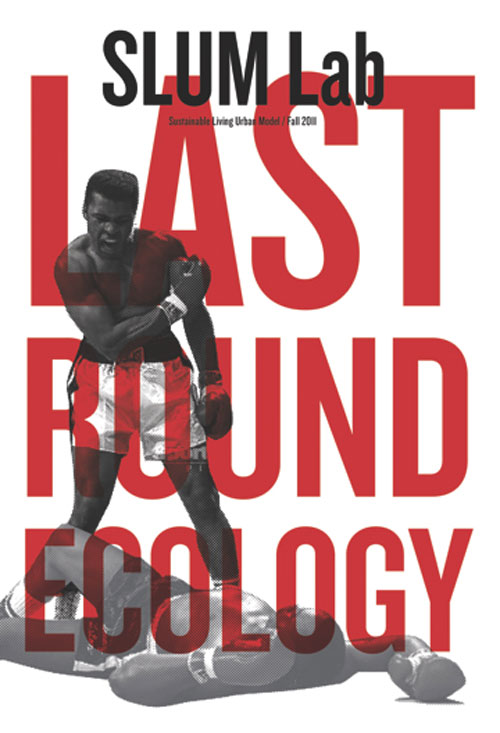
This week I met with Denise Hoffman Brandt and Alfredo Brillembourg to discuss concepts of ecology in design as well as necessity, relevance and content of the first issue of the newly published 'SLUM Lab magazine'.
 |
| Designers may become boxer-like fit to sustain their word-changing agendas. |
Initially I contacted Alfredo Brillembourg because of the work he is doing under the umbrella of 'Urban Think Tank' (UTT) which he founded in 1993 and now runs with Hubert Klumpner as co-director. UTT seeks to "deliver innovative yet practical solutions through the combined skills of architects, civil engineers, environmental planners, landscape architects, and communication specialists"[source]. The praxis which UTT exercises may be described in a nutshell as 'socially oriented architecture' [source] where architects (designers) function as agents of change to create catalytic interventions in urban areas (which are often underprivileged) across the globe making it possible that people can 'create a greater sense of responsibility to a stronger community'.[source]
One UTT project which exemplifies their catalytic approach and which has been widely recognized is the Metro Cable in Caracas which functions as transportation infrastructure which integrates community-relevant functions, thereby solving the problem that the city's underprivileged communities at the hilly fringe of the city have less access to the public transportation network.
 |
| Urban Thin Tank - Metro Cable, Caracas. [image courtesy of UTT] |
For our meeting in NYC Alfredo Brillembourg teamed up with Denise Hoffmann-Brandt, with whom he collaborates for editing the SLUM Lab magazine. Hoffmann-Brandt works in 'ecological urban landscape design' and directs the graduate landscape architecture program at the
City College New York, Spitzer School of Architecture. As a fellow at the
Van-Alen Institute, Hoffman-Brandt investigated the potential of urban carbon sinks for New York City in the project
CITY-SINK.
So o
ur group entered a productive conversation which was boosted by loud music and some coffee at Cafe Habana in the East Village. The following statements are marked according to the initials of Denise Hoffmann-Brandt (DHB), Alfredo Brillembourg (AB) and Florian Lorenz (FL).
ECOLOGY
FL: "I actually wanted to ask you guys how you employ the concept of ecology as ‘ecology’ is nowadays a very ubiquitous term. What does it mean for you when you use it? Because some people use it merely as a filler or as a beautification remark."
DHB: "It has become a very generic term, like sustainability. And in that sense it has lost its significant meaning which has to do with the system of relationships that sustain an organism with its environment. And so, if you think about ecological design, what you are really talking about is how you design systems of relationships which are active and time based, and that’s different from designing things. It’s a completely different approach to the process."
AB: "And you have to remember that the systems you are designing for are human beings."
DHB: "The organisms you are designing for tend to be weighted towards human beings. But the system is what you would call urbanism. But I actually see it as a bigger system and that’s why I talk about biosphere, because I think that we need to start to understand design not just as human centric. Maybe it’s time we get past all of that and start to see that we can’t sustain even human-social relationships if we don’t design for other species and design for the network. Ultimately we need to be designing within the biosphere system, not for one of its organisms."
SOCIAL ECOLOGY
FL: "That brings me actually to the next question. I am more and more interested in the concept of a social ecology. Because for me the social ecology is what is basically creating the artifacts we are living in and this whole anthroposphere we are related to. So I would suppose that a social ecology is a term you find useful."
AB: "All of the species we are talking about, all of them have a kind of social ecology, ants, bees, animals, all kinds, human beings. I guess what I would be more interested to tell you is how that all fits in with our world. Which is, where, what part of the forest is more fertile with organism? Do you know what part of the forest that is? It’s not deep in the forest, it’s on the edge."
DHB: "You are talking about the ecotone where you have a zone of transition between different ecological communities which stimulates diversity. Think of a forest as a macro system: living soils interrelated with growing and decomposing biomass; these are complex systems and conceptualizing social ecology fits into that idea of complexity. Social ecologies affect urban-ecological systems, as well as biosphere-ecological systems. Environmental relationships in ecosystems are impacted by social, cultural and particularly economic phenomena. So the question is: Are we designing to sustain human beings as a species or are we designing to sustain an economic system which we interpret as being necessary to support us, but which is actually undermining a lot of the other relationships that we require to persist?"
FRACTAL SIMPLICITY IN DESIGN
AB: "And about design I would want to say that it is actually those complex systems [which] should be tackled in very simple ways. In other words, design should be simple within that complexity. So, the simple and the complex. So it is Murray Gell-Mann, a Santa Fe researcher, [who] talked about the simple and the complex. So there is simplicity in that complexity. Or, a repeated element."
FL: "Like a fractal simplicity?"
AB: "A fractal, that’s right. So all you have to do to design well, I think, is to really understand the parameters of the issue."
DHB: "I call it 'finding the design logic' and, 'establishing the real criteria for design', which embraces complex conditions, but which actually has to come back to being fairly straight-forward criteria for performance."
AB: "And once you understand that criteria, the project comes out naturally. It’s a tweaking of that criteria. So the real project - that’s why research has become such an important thing – [is]; if you attack the design project from a research-analysis base intensely."
DHB: "That’s the only way you can establish criteria."
AB: "So it’s not a form-based, but it’s a process-based [approach]."
 |
| In conversation at Café Habana: Alfredo Brillembourg, Denise Hofmann-Brandt and Florian Lorenz. An open conversation implies that the interviewer can become the interviewed and vice-versa. |
After this exchange about (ecological) design theory, we focused the conversation about the first issue of the 'Slumlab Magazine' which Denise Hoffman-Brandt and Alfredo Brillembourg are editing together with Herbert Klumpner.
SLUMLAB MAGAZINE
FL: "So what is your SLUM Lab magazine about?"
AB: "Our SLUM Lab magazine - edited together with Denise and Hubert, my partner - is a magazine that we call ‘Last Round Ecology”. Last round because we are coming to the end, to the end of a cycle in which, if we do not start to change the mindset of how we think about the natural systems, and how design fits into those cycles, we are going to be in real trouble. As we can already see from the change in climate, form the droughts, from the pollution, from the devastation, from the infrastructural failures, etc."
DHB: "So the issue brings together people who’ve developed projects or whose design position takes a sort of confrontational approach to design in terms of ecological systems, whether its social ecologies, as you were talking about, or environmental systems. And we wanted to bring together a lot of projects that all were framed within this kind of systemic discourse. And we also - in seeing it as an ecological system in itself - wanted to build relationships, so the issue crosses institutional boundaries. People from ETH Zurich, City College, Columbia and other institutions and then we also cross disciplinary boundaries between urban design, architecture and landscape architecture. But in general the idea is: interpreting the social and environmental moment right now as sort of last round effort to start to design for future environmental systems and cities, then: How would you start to frame that design process? And that’s what the issue of SLUM Lab is about."
RELEVANT DESIGN FOR THE ANTHROPOSCENE
AB: "And if you don’t start to think about the planet as a whole, as pone urbanized planet, were really in a problem. You can’t look at it in sectorized, specialized, individualized parcels. You must start to think about the relationships between things. And in fact that’s why university is failing. It is failing to really teach anything useful to students because they are either learning very specialized programs, or Maya, or a design current, or a design fad."
DHB: "Even, just learning tactics for design without actually developing a kind of strategic base that would enable them to use these tactics in a meaningful way."
FROM TACTICS TO STRATEGY
AB: "So, more long term strategy! Tactics - short term - gets you by. You can get a job with a good talent in Maya, or a good program talent, but you need to understand what you are doing here. So the basic question is: Do departments at universities of architecture really understand the more long term reason why they are educating? And, where their research should go? So I ask you a question: Probably one of the most relevant new - in the last 20 years, post war - interesting ecological developments has been Curitiba, by Jaime Lerner as architect major, governor. As a city, Curitiba. What he did with waste, with transport, with water, is fantastic. And now, let me ask you a question: So many universities publishing so many books a year, so many intellectuals of architecture. We have more space in magazines, but we don’t really know what we are doing. Because there is not one book out there that tells you the story about Curitiba. So why is that?"
FL: "I guess because of the, how do you say, that unwillingness of systems to change. The friction they have against change."
BEYOND STAR DESIGNERS AND CAPITAL MARKETS
AB: "Well, we are just promoting star designers. We can’t get away from it. We are selling our star designers to get students, foreign students, to come to our universities."
DHB: "Well if we didn’t have star designers you wouldn’t have architecture that was capable of participating in capital markets."
AB: "Actually, I don’t want them to participate in capital markets anymore. Because the truth is, can you imagine? [T]hey’ve recognized that they can build more shopping malls in China. And the shopping malls are not going to the major cities anymore like Shanghai, Hong Kong, and Beijing. They’re going to all the villages that are between 500 000 and a million inhabitants. So they see a potential for 30, 40, 50 villages to receive shopping malls now. That’s scary. So who’s behind the real change of urban form? Capital markets!"
DHB: "Capital markets. And so, architecture, design, landscape, urbanism - people who care about urbanism - must participate in capital markets. But they have to find a mechanism that will change the discourse of that participation from being subservient and supporting the market to actually taking control of what the market’s mission is. To remind society that that the market was devised as a structural apparatus to sustain society and culture, not to take it over, not to have society and culture put in position to sustain it."
FREE, INTELLECTUAL REVELATION
AB: "So with the Tahrir, the Arab spring, the Arab spring phenomena, very important for us, for the discourse is the change of mindset. Because people now have recognized that there is a power structure of [...] small groups of people in each field; architecture, banking, philosophy, they control basically the discourse and in that way the course of the way the world moves, right. That’s the one percent. And the general mass, the 99 percent, really have now say."
FL: "So how do you counteract this? It’s also a publishing problem. How do you change the discourse? What’s your approach with the slumlab magazine in this sense?"
DHB: "It’s free"
AB: "Exactly, it’s free, like the internet. It does require you to do much to create a real impact, right? So quit magazines, newspapers. Community, NGO, community design organizations can do a lot."
PRODUCTIVE DISCOURSE
DHB: "But let’s also face it. It has a lot to do with creating a kind of social milieu that is explosive and and grows and that’s where a magazine or something like that [comes in]. We need to rely on hype as much as the bankers need to rely on hype. And the question is: How to manage the process so that what stays foregrounded is a discourse where we are not going to always agree. You and I don’t agree on everything! But that we are continually talking and raising issues it needs to be dealt with. It’s not about coming from a kind of modernist position of rejecting the past, or whether we disagree with the current late capital system or not, it’s about figuring out how we can move forward with what we’ve got in a meaningful way. And part of that is actually being of the moment and creating a meaningful milieu of discourse."
AB: "We don’t have to create too much. We are actually preaching to the choir. The whole new generation is out there, is already in tune to it. They are already completely uninterested in the Zahas and Rem, occasionally, but certainly the Eisenmans, right? So, it’s really out there. It’s no big phenomena, it’s really happening: People want change."
So That sets he stage for the upcoming SLUM Lab magazine and the first issue 'Last Round Ecology'. I am looking forward to read (for free!!) the essays organized around themes such as Critical Mapping, Territorial Ecologies, Informality and Open Source, written by people such as: Lydia Kallipoliti, Catherine Seavitt, Georgeen Theodore, Deborah Gans, Pamela Puchalski, Nina Rappaport, Kenneth Frampton, Anne Guiney and Michael Sorkin and many more.
The question of freedom raised during our conversation brought another echo up in my mind: Who decides who is contributing what to the magazine? So in one sense the SLUM Lab magazine is (still) a classical magazine where there exists an information-bottleneck in the hands of the editors. I suppose in the context of the SLUM Lab magazine this bottleneck can be accepted as the outreach and aims of the magazine appear as very important and geared towards positive change.