Recently I visited
terreform, a non-profit dedicated to research into the forms and practices of just and sustainable architecture and urbanism, located in Manhattan, NYC. I wanted to find out more about a specific project, the 'self-sufficient skyscraper', which terreform presented during the 2010
Venice Biennale in the US '
workshopping' pavilion.
Terreform's contribution to the US pavilion at the Venice Biennale 2010. [image courtesy of terreform]
In relation to a 'self-sufficient skyscraper', I was interested in questions of how to achieve self-sufficiency, technological feasibility, social implications and a research-based design process integrating life-cycle concepts.
The 'Self-sufficient Skyscraper' is part of terreform's ongoing investigation '
New York City (Steady) State' about the possibility of New York city becoming entirely
self-sufficient within its political boundaries. The issues concerned in the study are: food, energy, water, waste, movement, buildings, air and climate.
'New York City (steady) State' features urban prototypes for (almost) closed loop systems at different scales, such as, the districts, neighborhoods, building blocks, barges on the water or detached single family houses.
The self-sufficient skyscraper extends this investigation to the realm of high rise buildings. In a nutshell, the project can be described as a habitable and sociable vertical urban farm in the dimension of a skyscraper.
The 'Self-sufficient Skyscraper' is a re-use proposal for the Verizon building North of the Brooklyn bridge landing in Manhattan. The building is conceptualized to house 500 people and follows the approach of creating vertical neighborhood supported by an agri-cultural production system which is largely closed (in terms of water and resource cycles) and tied to on-site energy generation (solar and biomethane) and minimized energy consumption (food, building and lifestyle needs). The 'self-sufficient skyscraper' houses various urban functions to support the social life in the city. Residential uses, farming areas, commercial floors, institutional programs as well as adaptable spaces are featured to bring the self sufficient skyscraper to life.
Diagram of water and waste cycles (click to enlarge). [image courtesy of terreform]
As a habitable vertical farm, the building is a homage to Dickson Despommier, advocate of the
vertical farm concept. The agricultural layout integrates
aeroponics for growing of vegetables (at lower water demand),
aquaponics producing proteins (
tilapia sp., the 'queen' of farmed fish) and small scale chicken husbandry (open air).
Agricultural concept for the self-sufficient skyscraper and technologies used (click to enlarge). [image courtesy of terreform]
The farming area of the building is calculated based on a dietary energy intake of 2000 kcal/person/day assuming a half-vegetarian low-fat diet for the residents. This conceptual approach reflects the discussion of how to mitigate the 'developed' countries' carbon and ecological footprint by limiting dietary energy uptake to a more modest level. This would result in a reduction of the footprint of the 'developed' world, which is currently over-feeding itself and wasting huge portions of the food energy available. Such a reduction will not necessarily be a limitation in terms of quality of life, rather a healthy alternative to increasing obesity and food-related illnesses.
Diagram of energy generation and use (click to enlarge). [image courtesy of terreform]
The 'self-sufficient skyscraper' features some interesting examples of green technologies and strategies. Most of the technologies in the project are market-ready at hand and could therefore be integrated in building in the near-term future. This could happen either in a rather condensed way as a vertical, almost machine-like urban farm (as the project described here), or as extensions and benign parasites for existing urban structures. In this sense the 'self-sufficient skyscraper' is a feasibility study for high-density urban farming.
The 24 levels of the building feature three water cycles, each with a '
living machine' (biofilter) for a cluster of eight floors, to clean the water before being recycled. The system is modeled after John Todd's version of the living machine, called the '
eco-machine'.
Detail view of an 'eco-machine' designed by John Todd Ecological Design for indoor wastewater treatment. [image by
John Todd Ecological Design]
Vertical axis wind turbine (VAWT) for urban application. [image and turbine by
Urban Green Energy]
Helium balloons coated with photovoltaics are designed to power the biggest part of electrical energy for the building. The concept was suggested in 2007 by Geotectura for the
2007 re:volt competition about how to power an urban block. The approach seems intriguing and technically feasible but will have to be developed further to solve problems of wind and directional positioning.
Experimental prototype for a photovoltaic helium balloon within the 'SunHopes' project of geotectura. [image by
geotectura]
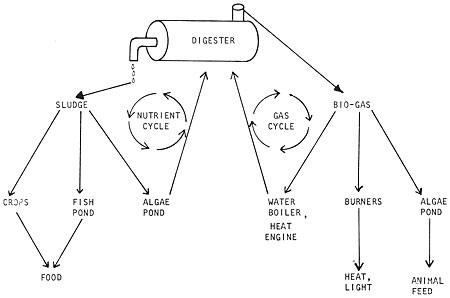
Methane digesters are market-ready and widely used. Urban applications and integration of methane digesters into buildings has yet to be adopted on a larger scale. We still waste huge amounts of nutrients (and thereby energy) by uncoupled nutrient cycles leading to dangerous nutrient levels in the natural environment.
Diagram showing basic function of an anaerobic biogas digester to manage human feces (separation important!) [image by Unesco via
PlanningPool]
Scheme for a methane digester integrated in an agricultural system to produce fuel gas and fertilizer. [figure by
John Fry]
Aeroponic farming is widely used in commercial farming worldwide and by a community of small scale farmers interested in pushing climate and spatial limits to urban agriculture. Aeroponics can
create a good income for urban farmers by producing cash crops with limited space in urban settings.
Aeroponics support root growth and nutrient uptake by plants leading to high growth rates at a lower water demand than conventional plant growing. [image by
trendgrinder]
Aquaponics unifies fish cultivation with hydroponic plant growing in a symbiotic system (nutrients traded for the cleaning of water). The concept is applied in community-based gardens in the
US and worldwide.
Next to the above mentioned technologies and strategies, the 'self-sufficient skyscraper' as well features state of the art green building technologies such as passive ventilation and double facades to lower energy demand of the building.
Technically the self-sufficient skyscraper is less utopian as in its social and economic functioning (Do New Yorkers really want to become part-time farmers? (I tend to answer: Yes, for enough of them to potentially fill a vertical farm.) How can a vertical farm compete economically with non-stacked farming practices?).
The economic feasibility of the 'self-sufficient skyscraper' has not been assessed yet but possible starting points for such a project would be public funding as a lighthouse project or a project run by a cooperative. As stated above, urban farming of cash-crops, especially if grown organically, can bring significant revenue.
The project of terreform shows that architects and designers have an important role in re-shaping imaginary representations of our society, especially under scenarios of diminishing resilience of ecological systems and limited energy availability. The 'self-sufficient skyscraper' can therefore be an opportunity to exemplify state-of-the-art green technologies, urban farming practices and social narratives so they may be discussed and further developed. This conversation will ideally be informed by wonder and excitement to nourish a debate about patterns of our food and energy consumption which sits at the very heart of issues such as climate justice, public health or social and environmental justice.
During my research for this post I didnt find any evidence of how efficient vertical urban farms are (energy and auxiliary input versus food output) if you take into account the construction process of the farms and on-site energy inputs. I still miss a full life-cycle assessment (in terms of energy) comparing vertical farms with for example community gardens or rooftop gardens. Nevertheless the concept is intriguing, provocative and obviously very attractive for designers who want to go green. It will have to be discussed what form of urban farm is the most efficient and in which way can and will society be part of such an endeavor. This discussion should only be teasered here, I will elaborate on that in a subsequent post focusing on vertical farm projects which have been proposed for NYC.