Showing posts with label urbanism. Show all posts

Jane's Walk Vienna

On Sunday May 4th I will be guiding a Jane's Walk in Vienna. This post contains some preparatory images I took. Please have a look into the walk's details on the website of Jane's Walks. 

As I just moved to Vienna's 9th district (Alsergrund) I decided to explore the area of the "University Center Althanstraße" encompassing the now vacant Business University buildings, the Institute of Ecology (where I studied, amongst others), as well as the Geology and Pharmacy Institutes.
I am happy about this initiative and am curious to see how we are going to walk, converse and vision about what this whole building complex can turn into in future. 

Meeting point: Sunday, 4th May, 5PM in front of Franz-Josephs Bahnhof.

Click images to enlarge! 


Bicycle Urbanism - Back to the Future City


Since the academic year 2013/14 a lecture series on "Cycling in the City" is being curated by the Research Center of Transport Planning and Traffic Engineering at Vienna University of Technology. This year we have been invited to share Smarter Than Car's viewpoint on Bicycle Urbanism. Watch the video here:

The talk will take place Monday 28th April at 6 PM at Vienna University of Technology. There will be live streaming within the university and the video recording of the talk will be put on line later, also within this post. ;) Looking forward to interacting with many interested students in Vienna!

departure City Hype ideas competition

Last year, departure, the creative agency of the City if Vienna launched a series of ideas competitions to bring forward creative ideas for urban innovation in Vienna and beyond. The 2013 issue of the ideas competition - Cycling Affairs - received more that 200 submissions.

With this year’s ideas competition departure launches a project that provides participants with the opportunity to reflect on what the brief calls a "solidarity city" - City Hype  - invites creative professionals and city enthusiasts to formulate their ideas for coexistence on an equal footing, to provide the city with a multifaceted, modern identity and to actively participate in shaping its future. 


The ideas competition is open for individuals, start-ups or collectives from various disciplines located in Vienna or internationally. The submission of multiple entries is possible. Please find the registration form here. 


To steer inspiration for first ideas of potential participants the team of departure came up with core areas and specific questions as relevant to the overall theme of the competition. These questions can be taken as points of departure for working on the ideas competition:

THE SOLIDARITY CITY
Which measures focus on justice and solidarity as basic prerequisites for the social interactions of the city dwellers?

THE NETWORKED CITY
How do technologies react to the requirements of a network society, to its high degree of innovative dynamism and advancing digitalization?

THE FLEXIBLE CITY
How can the requirements imposed by the revolution of the working environment be turned into practice and which new models for work, leisure time and life planning are imaginable?

THE OPEN CITY
Where is room for actively participating in the creation of communicative locations and how can we succeed in making the city a modern ‘place of action’ for all its inhabitants?

THE INTELLIGENT CITY
Which sustainable solutions can be developed for the future of a ‘smart city’ in terms of infrastructure, distribution and organization?

THE DETERMINED CITY
What are the tools and strategies required to meet both the needs of individuals and the challenges of the 21st century in a creative way and which lead to personal initiative for the benefit of the civil society? 


The competition's expert jury will be analysing the submitted projects according to the following criteria: 

• Creative quality
• Sustainability
• Potential for change
• Potential for activation
• Added value for the civil society

There are three jury prizes for the competition:  
  1. prize: EUR 7,000
  2. prize: EUR 5,000
  3. prize: EUR 2,500
As well as one "Public’s choice award" which will be awarded by a public vote and which will win € 3,000.

The timeline for the competition is as following:
  • Launch of ideas competition: April 15, 2014
  • Deadline for submissions: June 18, 2014
  • Public voting (for "Public Choice Award"): June 27 – July 20, 2014
  • Jury meeting (For defining three jury prizes.): August 2014
  • Award ceremony: September 2014
Read more about the ideas competition here and fond an English description here. 

Smarter Than Car - An Open-source Bicycle Urbanism Think Tank

We are gladly launching Smarter Than Car as a Think Tank engaged with questions of Bicycle Urbanism and Future Urban Mobility.

See our new beautiful website:

http://www.smarterthancar.com/


As an open-source Think Tank we reagulary host events bringing together people to discuss ideas and brew up projects. We are also preparing some projects for the upcoming months so keep an eye out on the new website. I will also keep some updates on flolo.org.

Talk "The Promise of Bicycle Urbanism" @ TEDx Vienna - The City 2.0

I recently gave a talk at the TEDx Vienna City 2.0 event. Running through this process and meeting the inspiring team and other speakers made me learn a lot. Thanks to everybody who supported me in preparing the talk and of course to the whole team at Smarter Than Car! :)

Here is the video.

"The mainstreamed bicycle as a tool for creating future cities is just starting to take-off. Can we imagine a city where the benchmark for successful urban development is how we are able to use pedal-powered vehicles?
The idea of such a bicycle urbanism is what Florian is working on with the Chinese-Austrian NGO Smarter Than Car. He will make you understand why the bicycle is the most effective way to restructure our cities to become fit for future urban challenges.
Florian explains why he believes that the bicycle is still massively under-explored in contemporary urban planning and administration. He shows examples of what we can learn from bicycle cultural exchange with a city like Beijing to re-think our cities along the lines of pop-up urbanism on two or three wheels."

A Day with The DJ Trike in Vancouver

Urban life can be rewarding and full of surprises. While staying in Vancouver, Canada this June to present the work of Smarter Than Car at Velo-city 2012, I had such a spontaneous urban encounter which demonstrated the power of (bi)cycles as urban tools to (temporarily) program sustainably functioning and culturally active urban landscapes animated by pedal-powered vehicles.
The day after the Velo-city 2012 conference all the stress was gone, participants had cheerfully wrapped up the conference and could still enjoy one day roaming around the city on their BiXi bikes provided to pedal-power Velo-city participants in Vancouver. So I left my hotel with this indestructible bicycle turning towards downtown Vancouver on Burrard street and; What?! I see a Chinese tricycle (sunlunche) on the sidewalk, adapted with a white box to be usable as a mobile DJ console. Very quickly it dawned on me that this must be Jonathan Igharas, a designer from Vancouver who creates (amongst others) cycles as adapted urban tools and who obviously was about to have a good time with one of his creations: The DJ Trike. 


With the work of Smarter Than Car we had previously even quoted The DJ Trike as an example of an autonomous urban infrastructure which is able to exploit the advantages of pedal-powered vehicles for cultural events in public space. What we found interesting back then was that The DJ Trike interpreted the diverse Chinese cargo bike (sunlunche) culture in a modern and beautifully designed way, whereas in China the multitude of cargo cycles appeared as backward and from the past (read more about it in this article by Smarter Than Car). 
As Jonathan Igharas puts it on his site, the DJ Trike is “a vehicle and platform for urban communication and interaction, as well a method to transcend common perceptions associated with current pedal powered transportation.” 

In this post I want to give you impressions of the urban play session which Jonathan Igharas lately performed for a wedding and which I was able to witness. This was not the ‘typical’ urban play session which the collective Labour of Love is performing with the DJ Trike, but showed the flexibility of pedal-powered vehicles when they are used as autonomous cultural devices at spontaneous (urban) events. The awe of people who just left the church being confronted with the DJ Trike playing love songs on the sidewalk of Burrard street was not to miss and showed that great cities need more culturally productive pedal-powered vehicles in operation. 
In this sense I want to wish Jonathan and the Labour of Love soundsystem all the best for their future endeavours! To keep updated on the DJ Trike please refer to the DJ Trike’s facebook or twitter and the facebook page of the Labour of Love Soundsystem.


The DJ Trike's home: Chinatown in Vancouver.

The DJ Trike has just been recovered (via social media) from being stolen and therefore the branding had to be renewed.

The Labour of Love soundsystem crew; Jonathan Igharas and Tobias Ottahal.

Urban Stories Beijing

I am looking forward to giving a talk in Zürich at ETH DARCH's Chair of Architecture and Urban Design run by Urban-Think Tank, alias Alfredo Brillembourg and Hubert Klumpner. The talk will be part of the Urban Stories lecture series which puts an emphasis on deciphering the underlying "urban plans, instruments, visions, political decisions, economic reasonings, cultural inputs and social organizations" which have produced a certain urban morphology. With this knowledge 'urban operational tools' shall be defined which collectively will form an operational urban toolbox as an "improvised manual to navigate theories".
It is a great opportunity to merge the research were doing in Beijing with Smarter Than Car with new insights into Beijing's urban development and contemporary urban morphology. 


ONE Lab 2012


Terreform ONE's team recently announced ONE LAB 2011: Future Cities.  The four week lab in Brooklyn will be a densely programmed 'socio-ecological exploration of the next metropolis'. 

 In the words of the organizers, the ONE*Lab profile:
 "
ONE Lab Summer 2012 on Future Cities will address the emerging discipline of global urbaneering by assembling a wide range of innovators from fields as diverse as, architecture, material science, urban design, biology, civil engineering and media art. 

ONE Lab is designed for students who wish to engage with the crossover of design and science.
This summer approximately 40 researchers will gather in New York City for 4 weeks of intense creative and scientific exploration. ONE Lab provides a unique opportunity for students to learn from internationally recognized scientists and renown designers and artists: Dr. Janna Levin, Dr. Nina Tandon, Dr. Dickson D. Despommier, Vito Acconci, Natalie Jeremijenko, Marc Forens and a host of TED Fellows.

O
NE Lab consists of Design Studio, Future Cities Seminar and Future Cities Workshops. The studio will be offered in two levels - one for professional designers and students enrolled in professional schools or departments of design; one for students and individuals of various experience and background. All workshops are beginner level and no previous knowledge or experience is required."
Please find further details on program, people, tuition and application on onelab,org.  

"Remidiate Ephemeral Meshworks"

Yes. Remediating ephemeral meshworks. A discoursive input created by the "Landscape Urbanism Bullshit Generator", a really funny and instructive tool scripted by the guys at ruderal. They claim, by the way, that the Landscape Architecture Bullshit Generator may remain their greatest contribution to the discipline. :))

In any case the tool opens a self-reflection window for the discipline which is really important. What do we want to say when writing on theory and practice? Which language do we take into the discourse and what meaning does it transport? In this sense the Landscape Urbanism Bullshit Generator questions everybody in the field to reconsider the lingo used in everyday work. 

Design Ecologies for Landscape Ecological Urbanism

This is a re-post of a text which I recently wrote for the summer 2011 issue of the newsletter of EFLA - The European Federation of Landscape Architects.

Hubei village and adjacent high rise developments. Shenzhen, China 2011 (image by M.Marsh)

Conceptualizing new design ecologies for landscape ecological urbanism 
"In this century, mankind’s biggest challenges like resource constraint, climate change, or global demographic shifts will be encountered in the urban realm. Over the last decade, concepts such as landscape urbanism, ecological urbanism, or, landscape ecological urbanism emerged in an attempt to negotiate the complexity of contemporary (mega)cities. Such approaches are currently the most advanced concepts for designing urban environments which are able to accommodate human life increasingly constrained by environmental pressures.
Nevertheless, in contemporary landscape practice and teaching, we still frequently witness a disconnect between goals like social justice, environmental credibility and cultural meaning of projects, while all of them appear equally important for designers in urbanism [1]. This note provides some inspirational theoretical input for landscape urbanism practice and summarizes an article which will be published in the first issue of the EFLA online journal later this year.
As designers in urbanism we may understand our practice as a guiding of urbanism; in which we equally observe, mitigate and create the processes constituting our urban environments. To juggle urbane aims such as environmental concerns, social justice and cultural vibrancy, one may anticipate putting the human subject in the center - but not in a traditionally humanist way by optimizing systems solely for human needs - rather creating landscapes of a networked human ecology, where a reciprocal responsibility between mankind and supporting ecosystem is possible and sought.
Recent theoretical discourse was to some extent focused on metrics of how to measure a sustainable urban development [2]. A simple benchmark worth exploring for landscape practice is the adoption of ecological debt and ecological credit where ecological impacts of (built) interventions in the landscape are assessed and compared to the state before the project. But are landscape ecological projects automatically socially just and culturally meaningful? I would answer no, but the integration of ecological narratives extended with an engaged human subject would provide an opportunity to create diverse, lively and meaningful urban landscapes featuring vibrant social ecologies.
In the worldwide urban laboratory there is huge demand and need for new concepts to be integrated into the design of urbanism. Here, designers in urbanism can engage themselves by providing research outcomes and tools previously developed, or, by applying conclusions in adaptive approaches on the ground or in landscape education. To understand one’s own work taking place with such a background can provide a vitally inspirational impulse to define one’s design and research ecology within the broader context of a globalized practice of landscape ecological urbanism" 


[1] To make a provocative point about disciplinary boundaries, I will in this article refer to the disciplines of landscape architecture, landscape planning, urban planning, urban design, architecture - all of which are engaged with urbanism – simply as designers in urbanism.
[2] The question why we mainly measure development of (urban) environments shall be discussed elsewhere. It is questionable if the concept of ‘development’ is in the long run compatible with the normative goal of ‘sustainability’.

International Invitational Exhibition on OCT-Loft Concept Design


Within the company URBANUS, we recently developed an urban design project dealing with upgrading industrial building stock to be used as a densly productive area for creative industrial production. The project was featured in the exhibition 'Re-Start' in Shenzhen's OCT-Loft cultural district in July and August 2011. Here I want to provide some background info about the project and images from the opening showing the different urban design proposals.
View over OCT-Loft area to be upgraded. (click to enlarge)
OCT (Overseas Chinese Town) was founded in 1985 in Shenzhen and until 1994 OCT industrial enterprises had developed into a corporation with 55 companies under its umbrella. In this regard OCT shows the speed of growth of industry in Shenzhen (and China in general) and that these industries are now increasingly shifting from secondary industrial production to tertiary, service based economies.

As curator Li Sha is explaining the context of the exhibition:
"Since 2004, OCT started to upgrade the remaining East Industrial Zone to the Creative Cultural Park (named OCT-Loft). The upgrade of the Eastern Industrial Zone in Overseas Chinese Town to the Creative Culture park (OCT-Loft) shows it only took 26 years to complete the transformation of a European industrial city that was projected to take 100 years. [...] 
In recent decades, with the transformation and decline of large industrial systems in Europe and in the US, the protection and regeneration of earlier industrial heritage became a trend. The industry was upgraded as the region became increasingly more well known; however, the site is protected both by a respect for the natural surroundings and by archaeological practices, one that places extreme respect on the context and space. [...] 
'Landschaftspark Duisburg Nord' (Latz&Partner, 1990-1999). Industrial heritage carefully re-purposed with respectful archaeological approach. (Image source: wikipedia)

Upgrading of these areas will undoubtedly protect the industrial architectural heritage, and enrich the city's creative cultural space, but they have several issues: the area is difficult to adapt to the rapidly changing urban space; the aim for future development is unclear, and it could easily be transformed into a high-end fashion area; the area may have difficulty meeting the demand for new space in the region.
Zeche Zollverein in Essen, Germany. (image source and credit: Claus Moser @ Flickr)
Culturpark Westergafabriek. An old gasworks site refurbished to allow urban cultural events and host creative industrial entrepreneurs. (image by PLANETART @ Flickr]
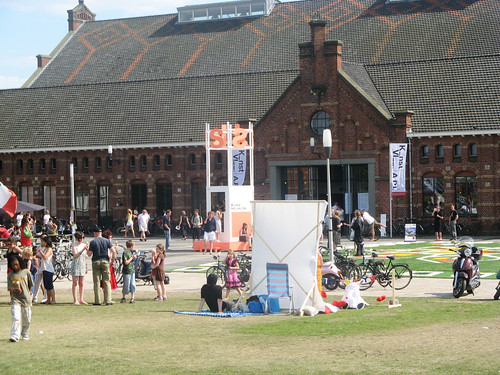
Culturpark Westergasfabriek, Amsterdam. The old 'gashouder' (gas storage tank) used for an exhibition. (image by Bas Boerman @ Flickr)
Culturpark Westergafabriek. The same gas storage tank as above used for a rave event. (image by Gia Vasilevska @ Flickr)
In fact, in Europe, another mode co-exists with the aforementioned strategy, that is the active protection mode. This mode also pays attention to the industrial architectural heritage and regional studies, but it is more concerned about the contemporary significance of the architectural and regional improvement. [...] 
The exhibition invited Bernard Tschumi Architects (New York / Paris), Dominique Perrault Architecture (Paris), MVRDV (Rotterdam), Urbanus - Architecture and Design (Shenzhen /Beijing) and Sou Fujimoto Architects (Tokyo) to offer thoughts on the OCT-Loft conceptual plan and the renovation of B10 into the OCT Contemporary Art Museum, exploring the strategy for the active protection of the industrial building."

It is fair to say here that this 'respect mentioned by Li Sha is not always a given in Europe. It is not uncommon that private as well as public investors just dont acknowledge or can imagine the heritage value of industrial buildings dating back a few decades. The problem in such a case is: you loose a type of architectural heritage, a unique form of space, which would be able to host an array of diverse events, being it cultural or representational. Such rough industrial heritage spaces may also provoke creative re-actions in these spaces which are impossible to create in sleek museum-like environments.There is something to architectural form which was created for another purpose in the past. So the really creative and culturally valuable act is actually a (sometimes temporary) re-purposing of industrial architectural heritage.
After this more theoretical and contextual introduction please have a look at some images of the contributions:

Bernard Tschumi Architects


Domique Perrault Architecture


MVRDV

URBANUS


Sou Fujimoto Architects