Showing posts with label energy. Show all posts

ONE Lab 2012


Terreform ONE's team recently announced ONE LAB 2011: Future Cities.  The four week lab in Brooklyn will be a densely programmed 'socio-ecological exploration of the next metropolis'. 

 In the words of the organizers, the ONE*Lab profile:
 "
ONE Lab Summer 2012 on Future Cities will address the emerging discipline of global urbaneering by assembling a wide range of innovators from fields as diverse as, architecture, material science, urban design, biology, civil engineering and media art. 

ONE Lab is designed for students who wish to engage with the crossover of design and science.
This summer approximately 40 researchers will gather in New York City for 4 weeks of intense creative and scientific exploration. ONE Lab provides a unique opportunity for students to learn from internationally recognized scientists and renown designers and artists: Dr. Janna Levin, Dr. Nina Tandon, Dr. Dickson D. Despommier, Vito Acconci, Natalie Jeremijenko, Marc Forens and a host of TED Fellows.

O
NE Lab consists of Design Studio, Future Cities Seminar and Future Cities Workshops. The studio will be offered in two levels - one for professional designers and students enrolled in professional schools or departments of design; one for students and individuals of various experience and background. All workshops are beginner level and no previous knowledge or experience is required."
Please find further details on program, people, tuition and application on onelab,org.  

LAGI Competition 2012: NYC Powered by Art

The Land Art Generator Initiative (LAGI) is hosting its's bi-annual design competition again in 2012 calling for a landscape art piece deeply embedded in it's genius lokus, which is stimulating people's imagination and is able to produce renewable energy.
The site for the 2012 LAGI competition is Freshkills Park at Staten Island, NYC which offers an amazing site for inspirational design ideas as the competition website describes:
"The expansiveness of the design site at Freshkills Park presents the opportunity to power the equivalent of thousands of homes with the artwork. The stunning beauty of the reclaimed landscape and the dramatic backdrop of the Manhattan skyline will provide an opportune setting from which to be inspired, and it offers the perfect environment for a showcase example of the immense potential of aesthetically interesting renewable energy installations for sustainable urban planning."

To support networked and international design teams LAGI also hosts a social networking site, the town square, which connects individuals and teams of designers, scientists, consultants etc to form teams competing in the 2012 LAGI competition.

So all factors, wonderful site, exciting brief as well as supportive work environment are set to produce interesting proposals for the 2012 LAGI competition. The jury, also staffed with prominent designers like Bjarke Ingels or James Corner will for sure have a great time choosing the best proposals. I am curious to see how entries differ this time from the results of the 2010 LAGI competition which was located in a very different site, Dubai UAE.

Nuclear China

The recent disaster in Fukushima, Japan has demonstrated that atomic power is a form of energy supply coming with high risks attached which cannot be fully controlled. Now China is starting into on a nuclear future and my recent visit made me aware of the scale of the operation. To quote some numbers:
"Mainland China has 14 nuclear power reactors in operation, more than 25 under construction, and more about to start construction soon.  
Additional reactors are planned, including some of the world's most advanced, to give more than a ten-fold increase in nuclear capacity to at least 80 GWe by 2020, 200 GWe by 2030, and 400 GWe by 2050.  
China is rapidly becoming self-sufficient in reactor design and construction, as well as other aspects of the fuel cycle."  [source]
Urban nuclear energy in Beijing, China. Beijing' s CBD is the conglomerate of darker buildings in the right rear. 
With China becoming a nuclear nation there is growing concern of how safe the industry may be. The recent train accident in Wenzhou province has sparked a fierce controversy and some connect the mistakes made within the railway administration to possible flaws in the nuclear power sector.
"China is embarking on the world's biggest and fastest expansion of nuclear power. The world must pray the industry will somehow prove immune to the curse of corner cutting, secrecy and corruption – or the potential consequences are chilling." [source]
If future events could be wished for like christmas presents, there are two things to write on a wish list:
That China's leaders know the responsibility and risks attached to nuclear power and take the industry serious enough.
That China's expansion of green energy will be more successful and faster that the expansion of nuclear power.

Summer School: Energy Landscapes 3.0

If you are free during the last week of July and engaged with the more and more regarded topic of energy landscapes, you may apply for a nice summer school with high profile advisors (and totally reasonable cost).
Bauhaus Dessau is organising a summer workshop Energy Landscapes 3.0, which aims to "analyse potential network geographies and concepts and their impacts on settlement structures in Europe. We will thereby explicitly refer to a chronicle of utopian thought on a large scale – visionary ideas for new Energy Landscapes promulgated decades ago by Sörgel in 1928 with Atlantropa and Richard Buckminster Fuller with his World Game in 1972."
An interesting detail from the synopsis of the summer school is that contemporary large scale fossil infrastructures should be redesigned in a 'smart' way. If we want to continue to use a comparable amount of energy (on a global scale) as we use today, we will have to innovate on a large spatial scale to complement a a dispersed renewable energy system of small power producing units. As stated earlier, it is important that designers engage in this discourse so that these new types of infrastructures can be welcomed by society and their additional values (as open spaces) appreciated. in this vein, the summer school has a great outreach of attracting participants from a wide range of disciplinary fields. 
The summer school Energy Landscapes 3.0 will be an opportunity to work with leading people within the landscape architecture profession and academia. For more information you may refer to the webpage of the summer school.
I am looking forward to the outcomes of the workshop and would appreciate if resulting designs and approaches are published online or in print. 

Why We Need a Renewable Strategy

The invisible atomic horror in case of an uncontrollable nuclear hazard is becoming by far too real in case of the tsunami struck nuclear power plant Fukushima in Japan. Do we have to risk such hazards to supply at most 14% of global energy demand? [source]
I was struck today by this image below, almost like from a horror movie or a bad action-film-like dream. I abstained so far to blog about this, but now cant resist to reproduce some images here which I suppose will become part of global subconscious (fearful) image about nuclear power.
Inside the Fukushima plant. Workers risking their lives becoming heroes of Japan. [image via derstandard copyright by APA]

[image source and copyright welt.de]

The recent disaster, or 'incident', produces weather forecasts which are uniquely more than material for small talk.
The global perspective on the dispersal of Caesium 137 as released from Fukushima, modeled by ZAMG (click to enlarge). [source and copyright ZAMG]

[image source dailymai.uk, copyright Reuters]

LAGI Competition 2010, Winner 'Lunar Cubit' Announced

The Land Art Generator Initiative (LAGI) recently announced the winner of their 2010 LAGI design competition. According to the competition brief, the project should propose energy generating public art which is culturally valuable, approachable for people and environmentally sound. There were many very creative and forward-looking entries for the competition and the jury for sure didn't have an easy time to decide about the winner.

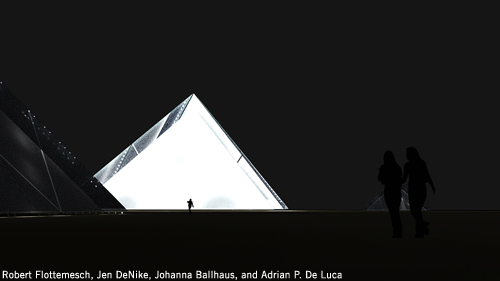
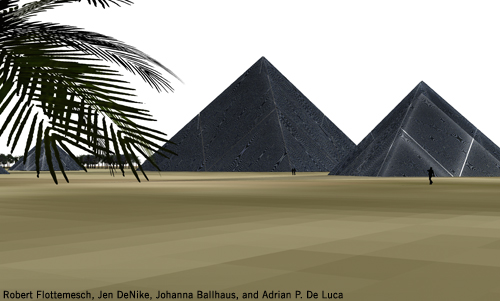
During the recent 2011 World Future Energy Summit in Abu Dhabi, the winning project 'Lunar Cubit' was announced. The project was developed by Robert Flottemesch, Jen DeNike, Johanna Ballhaus and Adriana P. De Luca and designed to be located at an intersection on the road connecting Masdar city with Abu Dhabi airport.
Lunar Cubit by night indicating the lunar cycle [image copyright by competition team]
 from the project description:
"Lunar Cubit is a site specific proposal to be constructed in Abu Dhabi just outside Masdar City, the world’s first zero carbon metropolis once completed. Combining artistic vision with sustainable design and engineering, Lunar Cubit examines the nature of time through nightly contemplation of lunar phases and daily transformation of sunlight into electricity, powering up to 250 homes. Inspired by astronomy, quantum physics and the photoelectric effect, for which Einstein received the Nobel Prize in 1921, this work is open to the public, inviting a personal experience where one can literally reach out and touch a 1.74MW utility scale power plant, in the form of nine monolithic pyramids rising from the sands of Abu Dhabi.
Lunar means relating to or involving the moon and cubit is the name given to the oldest recorded units of length; employed though antiquity, the oldest cubit being the royal cubit, dating back to the Step Pyramid of Djoser circa 2,700 B.C." [source]

Lunar Cubit by day, an approachable public sculpture. [image copyright by competition team]
You can study the proposal more in-depth with the low-res competition pdfs or on the Lunar Cubit webpage.
I wish the team all the best in realizing this proposal and hope that similar projects, where art, energy generation and public space are coming together, will be more frequent in other parts of the world as well!

Terreform's Self-sufficient Skyscraper

Recently I visited terreform, a non-profit dedicated to research into the forms and practices of just and sustainable architecture and urbanism, located in Manhattan, NYC.  I wanted to find out more about a specific project, the 'self-sufficient skyscraper', which terreform presented during the 2010 Venice Biennale in the US 'workshopping' pavilion. 
Terreform's contribution to the US pavilion at the Venice Biennale 2010. [image courtesy of terreform] 

In relation to a 'self-sufficient skyscraper', I was interested in questions of how to achieve self-sufficiency, technological feasibility, social implications and a research-based design process integrating life-cycle concepts.   
The 'Self-sufficient Skyscraper' is part of terreform's ongoing investigation 'New York City (Steady) State' about the possibility of New York city becoming entirely self-sufficient within its political boundaries. The issues concerned in the study are: food, energy, water, waste, movement, buildings, air and climate. 
'New York City (steady) State' features urban prototypes for (almost) closed loop systems at different scales, such as, the districts, neighborhoods, building blocks, barges on the water or detached single family houses. 
The self-sufficient skyscraper extends this investigation to the realm of high rise buildings. In a nutshell, the project can be described as a habitable and sociable vertical urban farm in the dimension of a skyscraper. 
The 'Self-sufficient Skyscraper' is a re-use proposal for the Verizon building North of the Brooklyn bridge landing in Manhattan. The building is conceptualized to house 500 people and follows the approach of creating vertical neighborhood supported by an agri-cultural production system which is largely closed (in terms of water and resource cycles) and tied to on-site energy generation (solar and biomethane) and minimized energy consumption (food, building and lifestyle needs). The 'self-sufficient skyscraper' houses various urban functions to support the social life in the city. Residential uses, farming areas, commercial floors, institutional programs as well as adaptable spaces are featured to bring the self sufficient skyscraper to life.
Diagram of water and waste cycles (click to enlarge). [image courtesy of terreform]

As a habitable vertical farm, the building is a homage to Dickson Despommier, advocate of the vertical farm concept. The agricultural layout integrates aeroponics for growing of vegetables (at lower water demand), aquaponics producing proteins (tilapia sp., the 'queen' of farmed fish) and small scale chicken husbandry (open air).

Agricultural concept for the self-sufficient skyscraper and technologies used (click to enlarge). [image courtesy of terreform]

The farming area of the building is calculated based on a dietary energy intake of 2000 kcal/person/day assuming a half-vegetarian low-fat diet for the residents. This conceptual approach reflects the discussion of how to mitigate the 'developed' countries' carbon and ecological footprint by limiting dietary energy uptake to a more modest level. This would result in a reduction of the footprint of the 'developed' world, which is currently over-feeding itself and wasting huge portions of the food energy available. Such a reduction will not necessarily be a limitation in terms of quality of life, rather a healthy alternative to increasing obesity and food-related illnesses. 

 Diagram of energy generation and use (click to enlarge). [image courtesy of terreform]

The 'self-sufficient skyscraper' features some interesting examples of green technologies and strategies. Most of the technologies in the project are market-ready at hand and could therefore be integrated in building in the near-term future. This could happen either in a rather condensed way as a vertical, almost machine-like urban farm (as the project described here), or as extensions and benign parasites for existing urban structures. In this sense the 'self-sufficient skyscraper' is a feasibility study for high-density urban farming.

The 24 levels of the building feature three water cycles, each with a 'living machine' (biofilter) for a cluster of eight floors, to clean the water before being recycled. The system is modeled after John Todd's version of the living machine, called the 'eco-machine'.
Detail view of an 'eco-machine' designed by John Todd Ecological Design for indoor wastewater treatment. [image by John Todd Ecological Design]

Wind turbines are integrated on some floors of the building to generate a fraction of baseline energy use. Wind Turbines for small scale urban applications are market ready but their real energy generation capacity still needs to be assessed. 
Vertical axis wind turbine (VAWT) for urban application. [image and turbine by Urban Green Energy]

Helium balloons coated with photovoltaics are designed to power the biggest part of electrical energy for the building. The concept was suggested in 2007 by Geotectura for the 2007 re:volt competition about how to power an urban block. The approach seems intriguing and technically feasible but will have to be developed further to solve problems of wind and directional positioning. 

Experimental prototype for a photovoltaic helium balloon within the 'SunHopes' project of geotectura. [image by geotectura]

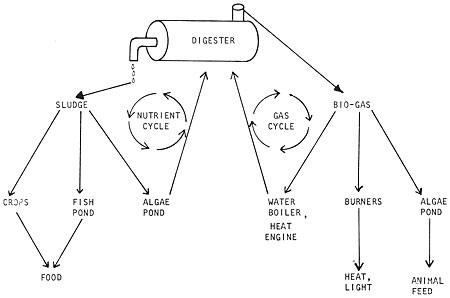
Methane digesters are market-ready and widely used. Urban applications and integration of methane digesters into buildings has yet to be adopted on a larger scale. We still waste huge amounts of nutrients (and thereby energy) by uncoupled nutrient cycles leading to dangerous nutrient levels in the natural environment. 

 Diagram showing basic function of an anaerobic biogas digester to manage human feces (separation important!) [image by Unesco via PlanningPool]


Scheme for a methane digester integrated in an agricultural system to produce fuel gas and fertilizer. [figure by John Fry]

Aeroponic farming is widely used in commercial farming worldwide and by a community of small scale farmers interested in pushing climate and spatial limits to urban agriculture. Aeroponics can create a good income for urban farmers by producing cash crops with limited space in urban settings.
Aeroponics support root growth and nutrient uptake by plants leading to high growth rates at a lower water demand than conventional plant growing. [image by trendgrinder]
Aquaponics unifies fish cultivation with hydroponic plant growing in a symbiotic system (nutrients traded for the cleaning of water). The concept is applied in community-based gardens in the US and worldwide.
 Scheme for an aquaponic system to cultivate tilapia sp. and various vegetables. [image by UVI Aquaculture Program]

Next to the above mentioned technologies and strategies, the 'self-sufficient skyscraper' as well features state of the art green building technologies such as passive ventilation and double facades to lower energy demand of the building. 

Technically the self-sufficient skyscraper is less utopian as in its social and economic functioning (Do New Yorkers really want to become part-time farmers? (I tend to answer: Yes, for enough of them to potentially fill a vertical farm.) How can a vertical farm compete economically with non-stacked farming practices?).
The economic feasibility of the 'self-sufficient skyscraper' has not been assessed yet but possible starting points for such a project would be public funding as a lighthouse project or a project run by a cooperative. As stated above, urban farming of cash-crops, especially if grown organically, can bring significant revenue.

The project of terreform shows that architects and designers have an important role in re-shaping imaginary representations of our society, especially under scenarios of diminishing resilience of ecological systems and limited energy availability. The 'self-sufficient skyscraper' can therefore be an opportunity to exemplify state-of-the-art green technologies, urban farming practices and social narratives so they may be discussed and further developed. This conversation will ideally be informed by wonder and excitement to nourish a debate about patterns of our food and energy consumption which sits at the very heart of issues such as climate justice, public health or social and environmental justice.

During my research for this post I didnt find any evidence of how efficient vertical urban farms are (energy and auxiliary input versus food output) if you take into account the construction process of the farms and on-site energy inputs. I still miss a full life-cycle assessment (in terms of energy) comparing vertical farms with for example community gardens or rooftop gardens. Nevertheless the concept is intriguing, provocative and obviously very attractive for designers who want to go green. It will have to be discussed what form of urban farm is the most efficient and in which way can and will society be part of such an endeavor. This discussion should only be teasered here, I will elaborate on that in a subsequent post focusing on vertical farm projects which have been proposed for NYC.

Gravitation Water Vortex Power Plant

The other day I stumbled upon a fascinating small scale hydropower plant - the 'gravitation water vortex plant' - as developed by the Austrian engineer Franz Zotloeterer, who holds the patent for the turbine technology. 
The plant is transforming the mechanical energy produced inside a water vortex and  has great potential for small scale installations. The maximum energy output for this technology is estimated to be about 150 kW at an efficiency of about 70% and a minimum falling height of 0,7 meters.  [source]
 
The main pros of the 'gravitation water vortex plant' are: 
- No regulation system necessary.
- Minor flotsam is able to pass the turbine.
- Fish can pass the plant in both directions.
- The water gets aerated leading to better microbial growth and breakdown of nutrient charge in water. 
- The low falling height allows a better integration into the landscape. 


Because of the above reasons this type of hydro power can be realized in relatively flat landscapes, integrated into river restorations (with synergistic effects) or included in wastewater treatment plants. 
One may as well think about planning small gravitation water vortex power plants as being integrated in urban graywater discharge sewers. There they could create electricity used in pumping rainwater during storm events.
Three types of grid integration are presented on Zotloeterer.com: 
- Parallel operation mode (direct injection into public power grid)
- Surplus energy into grid (energy not used by owner of plant is injected into public power grid) 
- Isolated operation mode (energy is exclusively used by plant owner and stored in other means, eg hot water etc.)

There are several pilot projects in place already which demonstrate the feasibility of this technology.

Obergrafendorf, Austria.
Zotloeterer Inc. installed a pilot 'gravitation water vortex power plant' in Obergrafendorf, Austria, in 2006 . 
The installation cost about 60.000 € and produces about 7,5 kW. 


Schöftland, Switzerland. 
The first gravitation vortex power plant in Switzerland was inaugurated in 2010. The plant produces about 15 kW at an annual production of about 90000 kWh supplying 50 households with electricity.

The Vanuatu Pacifica Foundation

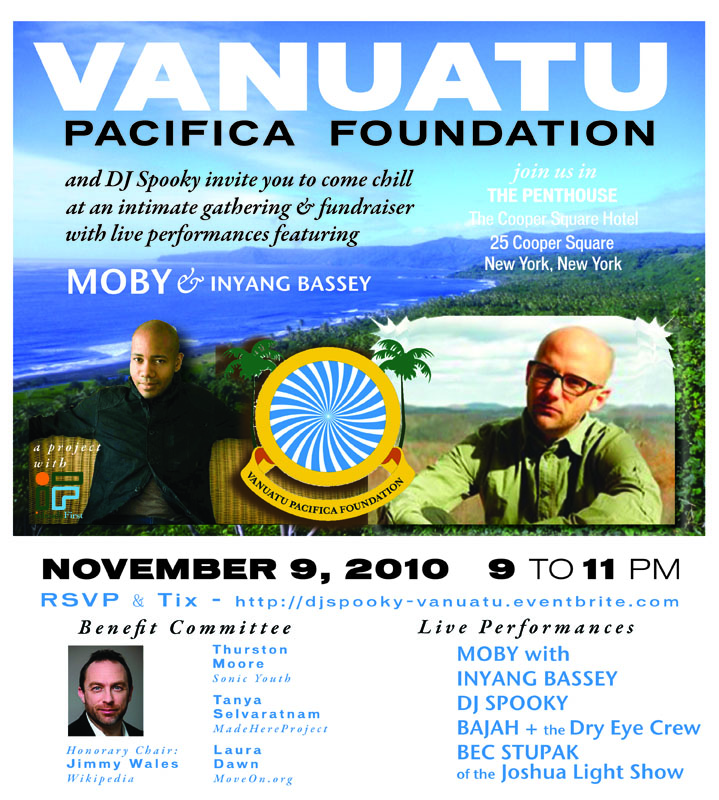
During an exhibition last week my attention was drawn to a project founded by Dj Spooky. Spooky, together with Jordan Schachter, set out to start 'The Vanuatu Pacifica Foundation' on the island Tanna in Vanuatu. The fundraiser party for this project will be next Tuesday, November 9th. You can get tickets here.

"The Vanuatu Pacifica Foundation's mission with Tanna Center for The Arts is to provide contemporary arts, green energy and education programming that builds thriving creativity and quality of life for all participants. The center is a contemporary arts retreat that provides haven to invited contemporary artists while serving the subsistence economy of three traditional villages on the island through clean energy, eco-restorative operations." [source]
  The project was started by Dj Spooky during a visit on the island of Tanna as he was taken away by the heartly people of Vanuatu. While people of Vanuatu resisted the promises of a modern, urban life for a long time they are now faced with rapidly loosing their culture as young people get taken over by modern lifestyles which consume their souls and culture. Only by searching images on google with 'Vanuatu' as keyword you can get a feel of how fragile, already consumed and endangered the culture in Vanuatu is. The question is not to maintain people in their lifestyle, keeping them as sort of reminescence to the past, rather the stake is to empower them so they can proudly steer their islands into a sustainable future. One big issue in Vanuatu is the loss of languages, therefore the project explicitly aims at working together with locals to develop strategies to give young people in Vanuatu 'a reason to stay' as Esso Kapum puts it. 
 This project promises an interesting endeavour for highly skilled and capable individuals from the creative sector to take a step out of their world and spend time on Tanna in a residency program (it is called 'residency-in-context'). There they will be challenged and inspired by a situation being both pristine but as well rapidly developing as Vanuatu is exposed to global pressures such as climate change or urbanisation. The participants should therefore "explore their practise in a sustainable context" and "balance their engagement with art-making, applied technology, village culture and the perpetuation of a pristine setting"[source]. The residency will as well develop the participant's worldview and help them to subsequently work with an enriched experience when being back home in the urban jungle. 
 The next step in the project is fundraising (which looks good on kickstarter) and a competition for the architectural and development concept of the Tannac center for the arts. If you are interested to receive information about the project, sign up for the mailing list.  

All in all this is a very noble and promising project which is setting high stakes. I wish that the project will be a great success and will continue to follow developments. This should be a lighthouse project for projects which aim to make a difference by providing cultures the possibility to learn from each other.

Mika Rottenberg's Squeeze

 Last Saturday Mika Rottenberg's solo show Squeeze opened at Mary Boone gallery. Rottenberg's piece was previously shown at San Francisco SFMOMA and will later travel to Europe (tba).

"Mika Rottenberg’s latest work Squeeze continues the artist’s inquiry into the mechanisms by which value is generated, considering the logistics of global outsourcing and the alchemy of art production. Through movie-magic portals, Rottenberg links video of her Harlem studio stage set to on-location footage of an iceberg lettuce farm in Arizona and a rubber plant in Kerala, India. This composite factory toils ceaselessly to create a single precious object, one small sculpture. The video is presented in a custom-made theater. The sculpture is inaccessible – preserved offshore, out of reach for public or private viewing." [source]
The white cube, viewing machine for the video Squeeze, inside the white shiny space of Mary Boone gallery in Chelsea. Everybody had to squeeze inside the box to watch the ~20mins video. You leave the bright scenery of a representative art opening and walk into a box where is becomes darker with the pace of your steps.
 The inside of the narrow exhibition space mirrors tactile qualities of exchangable office spaces across the globe. Acoustically perfectly tuned airconditioning and generic ceiling materials (asbestos?) comfort your way into the white box to watch the video of the machine which in turn features the same elements (aircon, ceiling, flowerpot). You are not outside the system.
Inside you are anonymous with the other spectators sitting in a box watching another box acting as machine and inevitably become part of what is happening in the video.I don't write too much here. Go and see the show yourself. ;)
The small sculpture, produced by the machine featured in the video, presented by Mary Boone. This image is sold as c-print in life-size.
Detail of the small sculpture. Resin holding together rubber, cosmetics and lettuce as analogies for female survival strategies in a society of capitalised bodies.
 The sculpture could have been a valuable artpiece, produced for a hungry global art market to make and represent money, exhibited around the world and traded among galleries, museums and curators. Rottenberg in turn decided to have it stored "in perpetuity" in the financial offshore hotspot Cayman Islands. Just as so much capital is sitting banked offshore, untaxed and useless for other purposes, Rottenberg's sculpture is locked away from the public and will slowely degrade in a crate inside of a warehouse on Cayman Islands (notice the shipping company 'Tropical Shipping'). Collectors can meanwhile buy shares of the blush-salad-rubber-cube which, just as any piece in the art market, may increase or decrease in value. Buying Rottenberg's art has become a real investment and metaphor of the functioning of the global art market intertwined with global business and industry.
Squirting air condition for a livable home on the outside of the installation.

Power supply. This detail of the installation was very intriguing for me. The power cord runs unhidden through half of the gallery before nurturing the video and providing conditioned air within the tight projection space. At one point during the opening a small boy almost unplugged the power supply for the installation. (Only his mother's courageous intervention could prevent the disaster!) This showed in a nice and coincidential way the fragility of the whole picture and as well the pressing issue of energy security which is so necessary to maintain a system of globalized capitalist production.
Squeeze was shot by Mahyad Tousi, the set built by Quentin Conybeare and spcial effects done by Katrin Altekamp. The aesthetics of the movie's working scenes reminded me of films such as 'Our Daily Bread', 'We Feed the World' or 'Workingmans Death' which, of course, are merely personal analogies. ;) 
 "
Squeeze
heavy mass
magnetic force
friction
a crack
a squeak
twinkling stars
electromagnetic fields
a buzzzzz
tongue flickers
fountain squirts
space expands
pressure applied to Rose's cheeks
Redness extracted
Iceberg Lettuce
Pure Latex Cream
pressure at its max
moist butts
bouncing ponytails
two holes align
ice crackles
temperature declines
space shrinks back to first position
shrinks, back to first position. Ingredients willed in, first layer is laid.” [source]

Mycelia Digested Materials for a Better World

I was very excited today during a TED talk of Eben Bayer, CEO of the company 'ecovative design', who presented ecovative's decomposable materials made with the help from fungi mycelia. Two materials are on the market already, 'ecocradle' for packaging and 'greensulate' for insulation purposes.

 [source]

The process is as smart as it is easy and environmentally benign. A wide array of lignocellulosic feedstock can be fitted into molds where its overgrown by the fungal mycelium which is partly processing the material and gluing it together. It takes five days to produce small packaging elements with a fraction of the energy used to produce a comparable styrofoam element. Ecovative materials are as well a perfect example of the 'craddle-to-craddle' concept as they can be readily composted in your backyard (if available) or centrally after collection. The 'ecovative' business model for global expansion foresees distributed production facilities which each use a local lignocellulosic feedstock.

There are some untold benefits as well. Carbon is stored temporarily in the products and it is easy to imagine how many CDEs can be put into a slower carbon cycle while being used as packaging material. From an urbanistic point of view these materials can be, amongst others, a way to enhance urban soils by decomposing a fraction of the material inflow to cities, thereby saving considerable amounts of primary energy used today for production and disposal of packaging products. The landscape field should be wide opened for these materials as well. There are so many materials used in landscape construction which would actually function in a better way if they became over time a structural component of the soil. hm...lets imagine.

It is good to know that a market-ready product is out there to compete with today's environmentally adverse packaging materials. I wish the team of ecovative all the best in their future development and am curious about more products which can be developed from mycelia-molded lignocellulosic materials. !!!

Study: Big Oil Goes to College.

A new study by Jennifer Washburn at the Center for American Progress investigates recent inflictions between big oil companies and universities in the US.
The report asks:
"Why are highly profitable oil and other large corporations increasingly turning to U.S. universities to perform their commercial research and development instead of conducting this work in-house? Why, in turn, are U.S. universities opening their doors to Big Oil? And when they do, how well are U.S. universities balancing the needs of their commercial sponsors with their own academic missions and public-interest obligations, given their heavy reliance on government research funding and other forms of taxpayer support?" [source]
And comes up with the following results:
"
The results of this report’s analysis of these 10 large-scale university-industry contracts raise troubling questions about the ability of U.S. universities to adequately safeguard their core academic and public-interest functions when negotiating research contracts with large corporate funders. This report identifies eight major areas where these contracts leave the door open to serious limitations on academic freedom and research independence. Here are just a few brief highlights:
  • In nine of the 10 energy-research agreements we analyzed, the university partners failed to retain majority academic control over the central governing body charged with directing the university-industry alliance. Four of the 10 alliances actually give the industry sponsors full governance control.
  • Eight of the 10 agreements permit the corporate sponsor or sponsors to fully control both the evaluation and selection of faculty research proposals in each new grant cycle.
  • None of the 10 agreements requires faculty research proposals to be evaluated and awarded funding based on independent expert peer review, the traditional method for awarding academic and scientific research grants fairly and impartially based on scientific merit.
  • Eight of the 10 alliance agreements fail to specify transparently, in advance, how faculty may apply for alliance funding, and what the specific evaluation and selection criteria will be.
  • Nine of the 10 agreements call for no specific management of financial conflicts of interest related to the alliance and its research functions. None of these agreements, for example, specifies that committee members charged with evaluating and selecting faculty research proposals must be impartial, and may not award corporate funding to themselves. (See summary of main findings for details, pages 52-59, and the Appendices beginning on page 75.)" [source]
You can download the full report here, or read more about it on the homepage of the Center for American Progress.

From a European perspective this report is a valid argument to be careful with letting private business into funding public universities. Only real academic freedom and non-steered research can come up with very important innovations for a benign development of future societies.

Motivated by Disaster

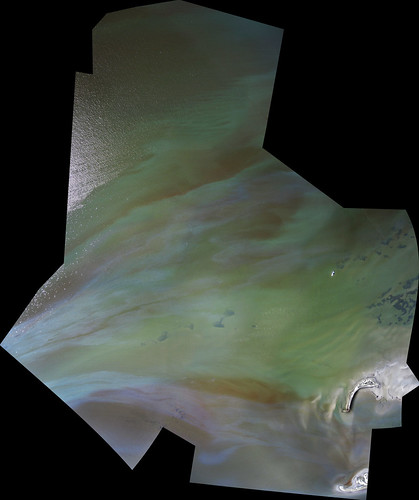
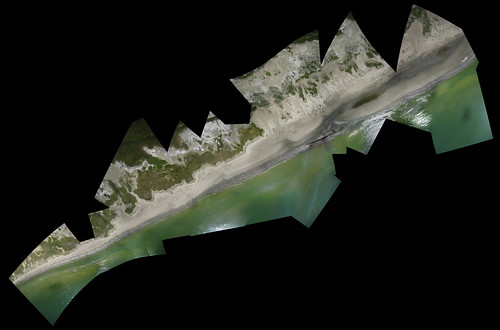
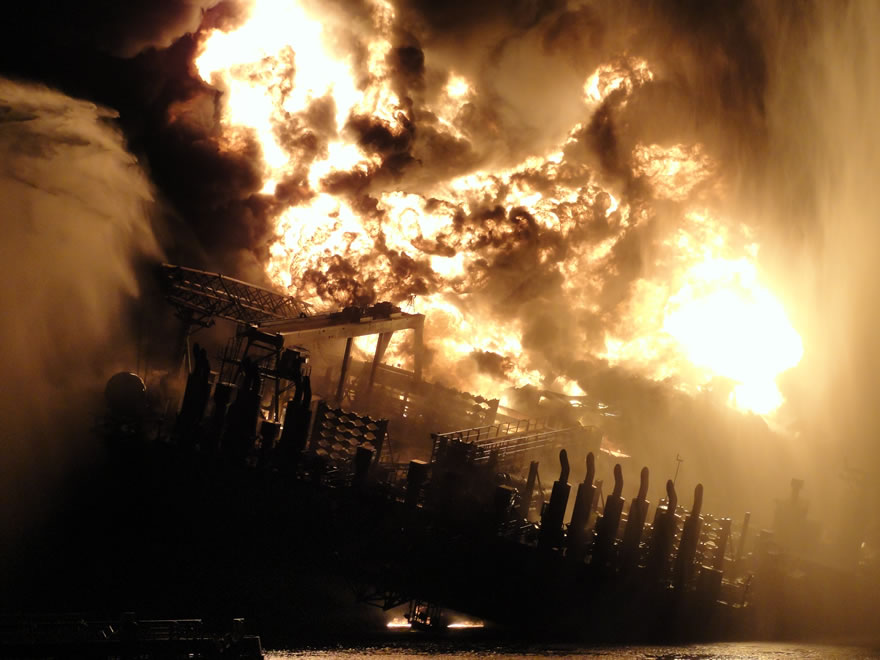
The deepwater horizon rig explosion and following oil spill can be stated to be the greatest environmental disaster in recent years.
Interestingly enough this spill created very strong bottom-up movements to cover the impact of the oil spill by grassroots mapping , crowdsource mapping or by providing an oil spill crisis map.

As terrible as the visual material of the oil spill may be. There are as well images, such as the ones below, which transport both, information about the state of the disaster, and, a certain abstract aesthetic. The imaginary below was aquired by gonzoearth with the means of kite-mapping and represent a strong symbol of how networks of individuals can empower themselves to control government and corporations in their promise of mitigating environmental damage.


I've been following press independent coverage and want to provide some important sources of information.

TEDxOilSpill. Comprehensive, in-depth information in TED-talk-style.
I was especially touched by Carl Safina's talk:


NY-Times: Paul Krugman on what didn't prevent the spill.


We can't allow oursleves to forget or underestimate the magnitude of this environmental desaster as caused by our contemporary societal-industrial-political system. Namely unregulated corporations and our energy system being trapped in a fossil pathway will have to be adressed to successfully prevent such disasters in future.


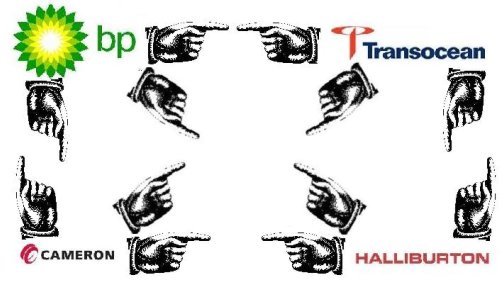
It should say 'we' in the center of the above figure, as ultimately we are the ones who buy gas at the pump every day driving our single-cars, using electricity and petrochemical disposable products. It's time for some new paradigms. Sustainable futures are plentiful.