Showing posts with label new york. Show all posts
Showing posts with label new york. Show all posts


United Colors of Benetton vs. The Ghost Bike
Everybody would agree that the bicycle has traveled all the way from being either sports tool or poor person's transportation to becoming a lifestyle, if not even a fashion accessory. And it is interesting to watch and find collateral damage happening on the way.
Last week I surfed the page of Curitiba Cycle Chic, an excellent source on fashion-related bicycle news and stories. There I found some images of Benetton's spring 2012 campaign featuring young, beautiful (and a bit meager) people colorfully dressed in Benetton's colorful collection riding bikes, of course. Yet, after a second or so I sensed my bewilderment with this scene. Well, those bikes are nice and painted white, entirely, so the colors come out better. Wait, didn't I see white bikes before somewhere?
 |
| Benetton spring campaign 2012. Image copyright and source: United Colors of Benetton. |
Interestingly enough the white bikes give the models something ghost-like. They seem flying atop the ground on heavenly, almost invisible vehicles.
 |
| Ghost bike in NYC, Brooklyn. |
 |
| Benetton spring campaign 2012. Image copyright and source: United Colors of Benetton. |
 | |
| Ghost bike in NYC, Manhattan. |
So please, dear fashion community, stay more closely interlinked with the communities you're feeding off in terms of inspiration and ideas (or at least hire somebody who does so). Addressing Benetton: please show some respect for the ghost bikes memorials worldwide. For stories about the people for whom the ghost bikes were placed as memorials, please refer to ghostbikes.org.
 |
| Two men holding (ghost)bikes in almost critical-mass-ish pose. Benetton spring campaign 2012. Image copyright and source: United Colors of Benetton. |
ONE Lab 2012
Terreform ONE's team recently announced ONE LAB 2011: Future Cities. The four week lab in Brooklyn will be a densely programmed 'socio-ecological exploration of the next metropolis'.

In the words of the organizers, the ONE*Lab profile:
"
ONE Lab Summer 2012 on Future Cities will address the emerging discipline of global urbaneering by assembling a wide range of innovators from fields as diverse as, architecture, material science, urban design, biology, civil engineering and media art.
ONE Lab is designed for students who wish to engage with the crossover of design and science.
This summer approximately 40 researchers will gather in New York City for 4 weeks of intense creative and scientific exploration. ONE Lab provides a unique opportunity for students to learn from internationally recognized scientists and renown designers and artists: Dr. Janna Levin, Dr. Nina Tandon, Dr. Dickson D. Despommier, Vito Acconci, Natalie Jeremijenko, Marc Forens and a host of TED Fellows.
ONE Lab consists of Design Studio, Future Cities Seminar and Future Cities Workshops. The studio will be offered in two levels - one for professional designers and students enrolled in professional schools or departments of design; one for students and individuals of various experience and background. All workshops are beginner level and no previous knowledge or experience is required."
Please find further details on program, people, tuition and application on onelab,org.
Warchild Revisit


Bicycle Mainstreaming
Following STC's Vienna lecture on bicycle cultural exchange between Beijing, New York and Vienna it was nice to see that some concepts were successfully introduced into public discourse.
During the talk I emphasized the importance of a process of 'bicycle mainstreaming' which could (in a nutshell) be understood as a process of supporting a broader understanding and support for the bicycle as viable means of providing urban transportation and to see the bicycle as equal participant next to people on foot or in cars. Traveling everyday commutes on bicycles in cities like Beijing, Vienna or New York makes one conscious about the importance of the bicycle mainstreaming concept.
Today (February 4th 2012) a google search returned three results for "bicycle mainstreaming", not too many if one thinks about the usefulness of such a concept. Two of those hits are by the way related to the work of "Smarter Than Car"... :)
To demonstrate the transition of the concept from the lecture into the broader discourse please find two images below, one of y slide in my presentation and another one from the article (in german) on the lecture's content which was published by the Austrian Federal News' website (ORF.at).
At 'Smarter Than Car we continue working that such a bicycle mainstreaming will become a more day to day process in Beijing and Vienna.
During the talk I emphasized the importance of a process of 'bicycle mainstreaming' which could (in a nutshell) be understood as a process of supporting a broader understanding and support for the bicycle as viable means of providing urban transportation and to see the bicycle as equal participant next to people on foot or in cars. Traveling everyday commutes on bicycles in cities like Beijing, Vienna or New York makes one conscious about the importance of the bicycle mainstreaming concept.
Today (February 4th 2012) a google search returned three results for "bicycle mainstreaming", not too many if one thinks about the usefulness of such a concept. Two of those hits are by the way related to the work of "Smarter Than Car"... :)
To demonstrate the transition of the concept from the lecture into the broader discourse please find two images below, one of y slide in my presentation and another one from the article (in german) on the lecture's content which was published by the Austrian Federal News' website (ORF.at).
At 'Smarter Than Car we continue working that such a bicycle mainstreaming will become a more day to day process in Beijing and Vienna.
 |
| Screen shot of the article on ORF.at. Dated 2011-09-27 |
 |
| Slide from the lecture.Dated 2011-05-18 |
LAGI Competition 2012: NYC Powered by Art
The Land Art Generator Initiative (LAGI) is hosting its's bi-annual design competition again in 2012 calling for a landscape art piece deeply embedded in it's genius lokus, which is stimulating people's imagination and is able to produce renewable energy.
The site for the 2012 LAGI competition is Freshkills Park at Staten Island, NYC which offers an amazing site for inspirational design ideas as the competition website describes:
"The expansiveness of the design site at Freshkills Park presents the opportunity to power the equivalent of thousands of homes with the artwork. The stunning beauty of the reclaimed landscape and the dramatic backdrop of the Manhattan skyline will provide an opportune setting from which to be inspired, and it offers the perfect environment for a showcase example of the immense potential of aesthetically interesting renewable energy installations for sustainable urban planning."

To support networked and international design teams LAGI also hosts a social networking site, the town square, which connects individuals and teams of designers, scientists, consultants etc to form teams competing in the 2012 LAGI competition.
So all factors, wonderful site, exciting brief as well as supportive work environment are set to produce interesting proposals for the 2012 LAGI competition. The jury, also staffed with prominent designers like Bjarke Ingels or James Corner will for sure have a great time choosing the best proposals. I am curious to see how entries differ this time from the results of the 2010 LAGI competition which was located in a very different site, Dubai UAE.
The site for the 2012 LAGI competition is Freshkills Park at Staten Island, NYC which offers an amazing site for inspirational design ideas as the competition website describes:
"The expansiveness of the design site at Freshkills Park presents the opportunity to power the equivalent of thousands of homes with the artwork. The stunning beauty of the reclaimed landscape and the dramatic backdrop of the Manhattan skyline will provide an opportune setting from which to be inspired, and it offers the perfect environment for a showcase example of the immense potential of aesthetically interesting renewable energy installations for sustainable urban planning."
To support networked and international design teams LAGI also hosts a social networking site, the town square, which connects individuals and teams of designers, scientists, consultants etc to form teams competing in the 2012 LAGI competition.
So all factors, wonderful site, exciting brief as well as supportive work environment are set to produce interesting proposals for the 2012 LAGI competition. The jury, also staffed with prominent designers like Bjarke Ingels or James Corner will for sure have a great time choosing the best proposals. I am curious to see how entries differ this time from the results of the 2010 LAGI competition which was located in a very different site, Dubai UAE.
Pissed-Off Christmas Tree

It is interesting to see that others are also concerned with discarded Christmas trees, such as Brooklyn based artist Michael Neff with his installation of hanging orphaned Christmas trees under the BQE.
@ Occupy Wall Street

R. Buckminster Fuller 'Operating Manual for Spaceship Earth' (1969) chapter 3. Comprehensively Commanded Automation (online at: Buckminster Fuller Institute)
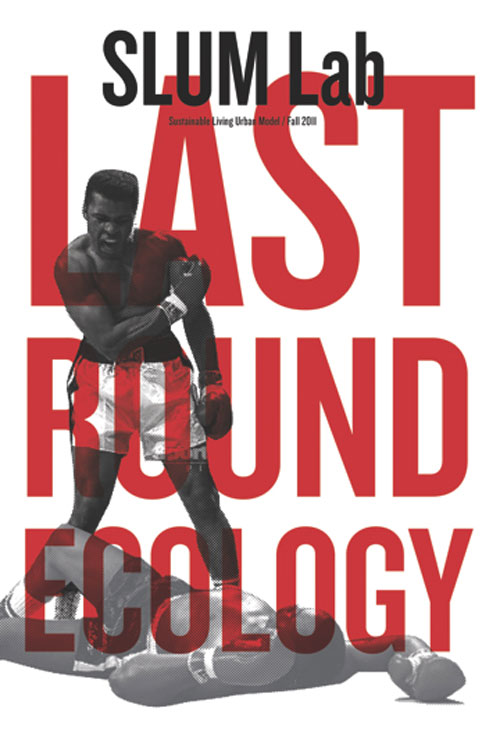
SLUM Lab Magazine: 'Last Round Ecology'
This week I met with Denise Hoffman Brandt and Alfredo Brillembourg to discuss concepts of ecology in design as well as necessity, relevance and content of the first issue of the newly published 'SLUM Lab magazine'.
 |
| Designers may become boxer-like fit to sustain their word-changing agendas. |
Initially I contacted Alfredo Brillembourg because of the work he is doing under the umbrella of 'Urban Think Tank' (UTT) which he founded in 1993 and now runs with Hubert Klumpner as co-director. UTT seeks to "deliver innovative yet practical solutions through the combined skills of architects, civil engineers, environmental planners, landscape architects, and communication specialists"[source]. The praxis which UTT exercises may be described in a nutshell as 'socially oriented architecture' [source] where architects (designers) function as agents of change to create catalytic interventions in urban areas (which are often underprivileged) across the globe making it possible that people can 'create a greater sense of responsibility to a stronger community'.[source]
One UTT project which exemplifies their catalytic approach and which has been widely recognized is the Metro Cable in Caracas which functions as transportation infrastructure which integrates community-relevant functions, thereby solving the problem that the city's underprivileged communities at the hilly fringe of the city have less access to the public transportation network.
 |
| Urban Thin Tank - Metro Cable, Caracas. [image courtesy of UTT] |
For our meeting in NYC Alfredo Brillembourg teamed up with Denise Hoffmann-Brandt, with whom he collaborates for editing the SLUM Lab magazine. Hoffmann-Brandt works in 'ecological urban landscape design' and directs the graduate landscape architecture program at the City College New York, Spitzer School of Architecture. As a fellow at the Van-Alen Institute, Hoffman-Brandt investigated the potential of urban carbon sinks for New York City in the project CITY-SINK.
So our group entered a productive conversation which was boosted by loud music and some coffee at Cafe Habana in the East Village. The following statements are marked according to the initials of Denise Hoffmann-Brandt (DHB), Alfredo Brillembourg (AB) and Florian Lorenz (FL).
ECOLOGY
FL: "I actually wanted to ask you guys how you employ the concept of ecology as ‘ecology’ is nowadays a very ubiquitous term. What does it mean for you when you use it? Because some people use it merely as a filler or as a beautification remark."
DHB: "It has become a very generic term, like sustainability. And in that sense it has lost its significant meaning which has to do with the system of relationships that sustain an organism with its environment. And so, if you think about ecological design, what you are really talking about is how you design systems of relationships which are active and time based, and that’s different from designing things. It’s a completely different approach to the process."
SOCIAL ECOLOGY
FL: "That brings me actually to the next question. I am more and more interested in the concept of a social ecology. Because for me the social ecology is what is basically creating the artifacts we are living in and this whole anthroposphere we are related to. So I would suppose that a social ecology is a term you find useful."
AB: "All of the species we are talking about, all of them have a kind of social ecology, ants, bees, animals, all kinds, human beings. I guess what I would be more interested to tell you is how that all fits in with our world. Which is, where, what part of the forest is more fertile with organism? Do you know what part of the forest that is? It’s not deep in the forest, it’s on the edge."
DHB: "You are talking about the ecotone where you have a zone of transition between different ecological communities which stimulates diversity. Think of a forest as a macro system: living soils interrelated with growing and decomposing biomass; these are complex systems and conceptualizing social ecology fits into that idea of complexity. Social ecologies affect urban-ecological systems, as well as biosphere-ecological systems. Environmental relationships in ecosystems are impacted by social, cultural and particularly economic phenomena. So the question is: Are we designing to sustain human beings as a species or are we designing to sustain an economic system which we interpret as being necessary to support us, but which is actually undermining a lot of the other relationships that we require to persist?"
FRACTAL SIMPLICITY IN DESIGN
AB: "And about design I would want to say that it is actually those complex systems [which] should be tackled in very simple ways. In other words, design should be simple within that complexity. So, the simple and the complex. So it is Murray Gell-Mann, a Santa Fe researcher, [who] talked about the simple and the complex. So there is simplicity in that complexity. Or, a repeated element."
FL: "Like a fractal simplicity?"
AB: "A fractal, that’s right. So all you have to do to design well, I think, is to really understand the parameters of the issue."
DHB: "I call it 'finding the design logic' and, 'establishing the real criteria for design', which embraces complex conditions, but which actually has to come back to being fairly straight-forward criteria for performance."
AB: "And once you understand that criteria, the project comes out naturally. It’s a tweaking of that criteria. So the real project - that’s why research has become such an important thing – [is]; if you attack the design project from a research-analysis base intensely."
DHB: "That’s the only way you can establish criteria."
AB: "So it’s not a form-based, but it’s a process-based [approach]."
 |
| In conversation at Café Habana: Alfredo Brillembourg, Denise Hofmann-Brandt and Florian Lorenz. An open conversation implies that the interviewer can become the interviewed and vice-versa. |
After this exchange about (ecological) design theory, we focused the conversation about the first issue of the 'Slumlab Magazine' which Denise Hoffman-Brandt and Alfredo Brillembourg are editing together with Herbert Klumpner.
SLUMLAB MAGAZINE
FL: "So what is your SLUM Lab magazine about?"
AB: "Our SLUM Lab magazine - edited together with Denise and Hubert, my partner - is a magazine that we call ‘Last Round Ecology”. Last round because we are coming to the end, to the end of a cycle in which, if we do not start to change the mindset of how we think about the natural systems, and how design fits into those cycles, we are going to be in real trouble. As we can already see from the change in climate, form the droughts, from the pollution, from the devastation, from the infrastructural failures, etc."
DHB: "So the issue brings together people who’ve developed projects or whose design position takes a sort of confrontational approach to design in terms of ecological systems, whether its social ecologies, as you were talking about, or environmental systems. And we wanted to bring together a lot of projects that all were framed within this kind of systemic discourse. And we also - in seeing it as an ecological system in itself - wanted to build relationships, so the issue crosses institutional boundaries. People from ETH Zurich, City College, Columbia and other institutions and then we also cross disciplinary boundaries between urban design, architecture and landscape architecture. But in general the idea is: interpreting the social and environmental moment right now as sort of last round effort to start to design for future environmental systems and cities, then: How would you start to frame that design process? And that’s what the issue of SLUM Lab is about."
RELEVANT DESIGN FOR THE ANTHROPOSCENE
AB: "And if you don’t start to think about the planet as a whole, as pone urbanized planet, were really in a problem. You can’t look at it in sectorized, specialized, individualized parcels. You must start to think about the relationships between things. And in fact that’s why university is failing. It is failing to really teach anything useful to students because they are either learning very specialized programs, or Maya, or a design current, or a design fad."
DHB: "Even, just learning tactics for design without actually developing a kind of strategic base that would enable them to use these tactics in a meaningful way."
FROM TACTICS TO STRATEGY
AB: "So, more long term strategy! Tactics - short term - gets you by. You can get a job with a good talent in Maya, or a good program talent, but you need to understand what you are doing here. So the basic question is: Do departments at universities of architecture really understand the more long term reason why they are educating? And, where their research should go? So I ask you a question: Probably one of the most relevant new - in the last 20 years, post war - interesting ecological developments has been Curitiba, by Jaime Lerner as architect major, governor. As a city, Curitiba. What he did with waste, with transport, with water, is fantastic. And now, let me ask you a question: So many universities publishing so many books a year, so many intellectuals of architecture. We have more space in magazines, but we don’t really know what we are doing. Because there is not one book out there that tells you the story about Curitiba. So why is that?"
FL: "I guess because of the, how do you say, that unwillingness of systems to change. The friction they have against change."
BEYOND STAR DESIGNERS AND CAPITAL MARKETS
AB: "Well, we are just promoting star designers. We can’t get away from it. We are selling our star designers to get students, foreign students, to come to our universities."
DHB: "Well if we didn’t have star designers you wouldn’t have architecture that was capable of participating in capital markets."
AB: "Actually, I don’t want them to participate in capital markets anymore. Because the truth is, can you imagine? [T]hey’ve recognized that they can build more shopping malls in China. And the shopping malls are not going to the major cities anymore like Shanghai, Hong Kong, and Beijing. They’re going to all the villages that are between 500 000 and a million inhabitants. So they see a potential for 30, 40, 50 villages to receive shopping malls now. That’s scary. So who’s behind the real change of urban form? Capital markets!"
DHB: "Capital markets. And so, architecture, design, landscape, urbanism - people who care about urbanism - must participate in capital markets. But they have to find a mechanism that will change the discourse of that participation from being subservient and supporting the market to actually taking control of what the market’s mission is. To remind society that that the market was devised as a structural apparatus to sustain society and culture, not to take it over, not to have society and culture put in position to sustain it."
FREE, INTELLECTUAL REVELATION
AB: "So with the Tahrir, the Arab spring, the Arab spring phenomena, very important for us, for the discourse is the change of mindset. Because people now have recognized that there is a power structure of [...] small groups of people in each field; architecture, banking, philosophy, they control basically the discourse and in that way the course of the way the world moves, right. That’s the one percent. And the general mass, the 99 percent, really have now say."
FL: "So how do you counteract this? It’s also a publishing problem. How do you change the discourse? What’s your approach with the slumlab magazine in this sense?"
DHB: "It’s free"
AB: "Exactly, it’s free, like the internet. It does require you to do much to create a real impact, right? So quit magazines, newspapers. Community, NGO, community design organizations can do a lot."
PRODUCTIVE DISCOURSE
DHB: "But let’s also face it. It has a lot to do with creating a kind of social milieu that is explosive and and grows and that’s where a magazine or something like that [comes in]. We need to rely on hype as much as the bankers need to rely on hype. And the question is: How to manage the process so that what stays foregrounded is a discourse where we are not going to always agree. You and I don’t agree on everything! But that we are continually talking and raising issues it needs to be dealt with. It’s not about coming from a kind of modernist position of rejecting the past, or whether we disagree with the current late capital system or not, it’s about figuring out how we can move forward with what we’ve got in a meaningful way. And part of that is actually being of the moment and creating a meaningful milieu of discourse."
AB: "We don’t have to create too much. We are actually preaching to the choir. The whole new generation is out there, is already in tune to it. They are already completely uninterested in the Zahas and Rem, occasionally, but certainly the Eisenmans, right? So, it’s really out there. It’s no big phenomena, it’s really happening: People want change."
So That sets he stage for the upcoming SLUM Lab magazine and the first issue 'Last Round Ecology'. I am looking forward to read (for free!!) the essays organized around themes such as Critical Mapping, Territorial Ecologies, Informality and Open Source, written by people such as: Lydia Kallipoliti, Catherine Seavitt, Georgeen Theodore, Deborah Gans, Pamela Puchalski, Nina Rappaport, Kenneth Frampton, Anne Guiney and Michael Sorkin and many more.
The question of freedom raised during our conversation brought another echo up in my mind: Who decides who is contributing what to the magazine? So in one sense the SLUM Lab magazine is (still) a classical magazine where there exists an information-bottleneck in the hands of the editors. I suppose in the context of the SLUM Lab magazine this bottleneck can be accepted as the outreach and aims of the magazine appear as very important and geared towards positive change.
There will be a magazine-launch party in New York on September the 16th at Van Alen Institute. RSVP if you want to enter a social milieu which aims at bringing design into a new era of higher environmental and social relevance.


Talk: New York's Pedal Power and Beijing's Bicycles
This Thursday, Smarter Than Car is hosting a lecture in Beijing, where Shannon, Liman and me will present some of our current research about bicycle culture in Beijing and New York. This event is a preview to an upcoming talk which STC will give at ‘UIA2011 Tokyo – The World Congress of Architecture’ later this year.
See the flyer for details (click to enlarge)

Linkliste "Lernen von Fahrradkulturen in Peking und New York"
BEIJING
http://www.stcbj.com/
"Smarter Than Car (STC) was set up as a platform for promoting cycling, the bicycle life and preserving Beijing’s unique cycling culture."
"Smarter Than Car (STC) was set up as a platform for promoting cycling, the bicycle life and preserving Beijing’s unique cycling culture."
NEW YORK CITY
http://www.nyc.gov/bikes
NYC - Department of Transportation's bicycle program with several initiatives.
http://www.nyc.gov/html/dcp/html/bike/home.shtml
"The goal of the Department of City Planning, New York City Department of Transportation, and the Department of Parks and Recreation Bicycle Network Development program is to reduce congestion by promoting cycling in New York City."
"The goal of the Department of City Planning, New York City Department of Transportation, and the Department of Parks and Recreation Bicycle Network Development program is to reduce congestion by promoting cycling in New York City."
http://www.streetfilms.org/bike-lanes-in-the-big-apple/
Short movie describing the development of bicycle infrastructure in NYC.
Short movie describing the development of bicycle infrastructure in NYC.
http://www.bikenewyork.org/
"Bike New York is a 501(c)(3) non-profit whose mission is to promote and encourage bicycling and bicycle safety through education, public events, and collaboration with community and government organizations."
"Bike New York is a 501(c)(3) non-profit whose mission is to promote and encourage bicycling and bicycle safety through education, public events, and collaboration with community and government organizations."
http://www.transalt.org/
"Our mission is to reclaim New York City's streets from the automobile, and to advocate for bicycling, walking and public transit as the best transportation alternatives."
"Our mission is to reclaim New York City's streets from the automobile, and to advocate for bicycling, walking and public transit as the best transportation alternatives."
http://bikingrules.org/
"Biking Rules is a new 'Street Code' for NYC cyclists, following the simple principle that our responsibility to others on the street increases in relation to our potential to cause harm."
"Biking Rules is a new 'Street Code' for NYC cyclists, following the simple principle that our responsibility to others on the street increases in relation to our potential to cause harm."
www.bikemonthnyc.org
"Each year the Department of Transportation and Transportation Alternatives team up to bring you Bike Month NYC, a city wide campaign to promote the joys of cycling in New York City."
"Each year the Department of Transportation and Transportation Alternatives team up to bring you Bike Month NYC, a city wide campaign to promote the joys of cycling in New York City."
http://rollingcarbon.org/
Rollingcarbon.org calculates the carbon impact of various New York City commutes.
Rollingcarbon.org calculates the carbon impact of various New York City commutes.
http://www.crashstat.org/
"For the first time, all New Yorkers had a way to see pedestrian and cyclist crashes in every neighborhood, enabling them to back up their first-hand experience of dangerous streets with comprehensive hard data."
"For the first time, all New Yorkers had a way to see pedestrian and cyclist crashes in every neighborhood, enabling them to back up their first-hand experience of dangerous streets with comprehensive hard data."
Recycle-a-bicycle is a community-based bike shop and non-profit organization that provides educational/job training programs and encourages environmental stewardship and everyday bicycle use.
"Right Of Way is a group of activists dedicated to asserting the rights of car-free street users -- including pedestrians, cyclists, and skaters -- and fighting back against car domination."
http://www.nycbikepolo.com/
http://www.nycbikepolo.com/
"Bike Polo has been played in New York since 2003. Now, our home court is The Pit at Chrystie & Broome Streets."
http://nybma.com/news/
http://nybma.com/news/
"The NYBMA is a worker’s alliance of the messenger, by the messenger, and for the messenger. Our mission is to unite, represent and advocate for the bike couriers of New York City."
http://www.fixed.gr/
"Home is where the harbl is."
http://www.iparkedinabikelane.org/
"I Parked In A Bike Lane.org is a humble movement aimed at raising driver awareness towards the problems associated with blocking bike lanes."
http://www.fixed.gr/
"Home is where the harbl is."
http://www.iparkedinabikelane.org/
"I Parked In A Bike Lane.org is a humble movement aimed at raising driver awareness towards the problems associated with blocking bike lanes."
"I write about mutant bikes, messenger events, bicycle technology and the vast realm of bicycle culture."
http://www.brooklynbybike.com/
http://www.brooklynbybike.com/
"Brooklyn by Bike was born out of a love for traveling around the city by bicycle. Others think we are crazy but we have a passion for our wheels like nothing else."
http://bikesnobnyc.blogspot.com/
http://bikesnobnyc.blogspot.com/
"While I love cycling and embrace it in all its forms, I'm also extremely critical. So I present to you my venting for your amusement and betterment."
http://brooklynspoke.wordpress.com/
http://brooklynspoke.wordpress.com/
"I’m a father, husband, writer, TV producer, comedian, and city cyclist. Just another voice in the ongoing discussion about city biking."
http://www.bikecult.com/
http://www.bikecult.com/
"The Bike Cult resource, a work in progress, includes listings of bike and cycling groups, velodromes, world and olympic champions, along with excerpts and updates from the book."
http://newamsterdamize.com/
http://newamsterdamize.com/
"We are dedicated to NYC’s Slow Biking Culture, guaranteed 100% Lycra-Free ! Relax. Enjoy your city."
http://www.astoriabike.com/
http://www.astoriabike.com/
"BikeHacks.com comes to you from both coasts of the USA. We write BikeHacks 'cause we love bikes. We dig up all kinds of cool, interesting and useful stuff, from the funky to the functional."
http://www.dykesonbikecycles.com/
http://www.dykesonbikecycles.com/
"We formed in spring ’06 to promote the integration and visibility of the existing community of queer bike riders."
http://www.flickr.com/photos/bicyclesonly/
"the purpose of almost all my photos is to inspire New Yorkers to make everyday trips by bicycle"
http://www.streetsblog.org/
"Streetsblog is a daily news source, online community and political mobilizer for the Livable Streets movement."
http://www.streetfilms.org/
"Streetfilms produces short films that show how smart transportation design and policy can result in better places to live, work and play."
INTERNATIONAL
http://thecityfix.com/
TheCityFix.com is an online resource for sustainable transport news, advocacy and “best practice” solutions from around the world.
http://www.copenhagenize.com/
"Each and every day roughly 500,000 citizens choose the bicycle in Greater Copenhagen. This blog highlights who they are, why they do and how it was made possible."
http://amsterdamize.com/
"I’m just an Amsterdam native who won’t take his city and its cycling extravaganza for granted anymore, thinking these posts might be clues for others, inspiration perhaps, if you will."
'Warchild' Streetart Project in Bushwick

Society is programming war into its youngest. Children are involved and suffer from numerous armed conflicts all over the world. War, a playful game or deadly reality? Some kids play in safety with war toys, while others, in less fortunate situations, may be taught to become child-soldiers or fall victim to the brutal face of war.
Instead of playing with war toys, children should be supported in becoming more tolerant to proliferate peace and understanding within a global society. In Mahatma Ghandi's words: “If we wish to create a lasting peace we must begin with the children”.
See also: meinwe


Learning from Bicycle Cultures in Beijing and New York
I will be giving a talk in Vienna as kind of cultural-learning event to inspire Vienna's efforts in raising bicycle ridership in the city and to support the creative use of pedal-powered vehicles by urban planners, designers and policy makers. The talk will feature Smarter Than Car's research on bicycle culture in Beijing, China and some recent efforts to understand New York's bicycle supporting strategies and specific culture.
The talk and a subsequent discussion will take place on May 18th 6:30 PM at 'Wiener Planungswerkstatt', 1010 Wien, Friedrich-Schmidt-Platz 9.
Poster (click to enlarge)

Outline (German):
Die Unterstützung von Lebensentwürfen die intensive Fahrradnutzung integrieren, kann einen wertvollen Beitrag für lebenswerte und kulturell diverse Stadtlandschaften leisten. Der Vortrag präsentiert Beispiele aus Peking und New York als kreativen Beitrag zur Weiterentwicklung der Wiener Fahrradkultur. In Peking untersucht Smarter Than Car Lebensstile und ökonomische Strategien verbunden mit dem Fahrrad, spezifische Fahrrad-Infrastrukturen und die hohe Diversität der Fahrradnutzung. Ein Blick nach New York zeigt eine stark auf Gemeinwesen aufbauende Fahrradkultur, die in jüngster Vergangenheit von progressiven Strategien der Stadtverwaltung unterstützt wird. Der Vergleich von Fahrradkulturen sowie Gesetzgebungen soll die Diskussion über die Positionierung der Wiener Fahrradkultur ermöglichen.
The talk and a subsequent discussion will take place on May 18th 6:30 PM at 'Wiener Planungswerkstatt', 1010 Wien, Friedrich-Schmidt-Platz 9.
Poster (click to enlarge)

Outline (German):
Die Unterstützung von Lebensentwürfen die intensive Fahrradnutzung integrieren, kann einen wertvollen Beitrag für lebenswerte und kulturell diverse Stadtlandschaften leisten. Der Vortrag präsentiert Beispiele aus Peking und New York als kreativen Beitrag zur Weiterentwicklung der Wiener Fahrradkultur. In Peking untersucht Smarter Than Car Lebensstile und ökonomische Strategien verbunden mit dem Fahrrad, spezifische Fahrrad-Infrastrukturen und die hohe Diversität der Fahrradnutzung. Ein Blick nach New York zeigt eine stark auf Gemeinwesen aufbauende Fahrradkultur, die in jüngster Vergangenheit von progressiven Strategien der Stadtverwaltung unterstützt wird. Der Vergleich von Fahrradkulturen sowie Gesetzgebungen soll die Diskussion über die Positionierung der Wiener Fahrradkultur ermöglichen.
Subscribe to:
Posts (Atom)