Ride for Your Rights!

There is an interesting bicycle-related event organized for European students which has been organized by the International Erasmus Student Exchange Network and Campus Europae.


'Ride for Your Rights! - It's Time to (Ex)Change Your Life' is a collective bicycle ride through countries of central and eastern Europe will take place this summer between July and September. The aim of the project is to raise awareness and support for student mobility of students in non-EC countries in central and eastern Europe. Departure is on the 3rd of July in Novi Sad, Serbia and the trek will reach its goal on September 15th in St.Petersburg.


The organizers describe the aim of the ride like: " We will cycle from the Balkans to Russia to raise awareness of the existing problems for student mobility. It must become possible for each and everyone of us to become a part of a mobile generation of young Europeans." 


If you are interested in participating, check the itinerary of the ride and meet up with others to converse and raise awareness while you are riding your bicycle. Alternatively you may check the ride's blog or youtube channel for impressions. 

Reaching a Critical Mass in Vienna

Participating in a critical mass (CM) ride can seriously change the image you have about your own city. This May's Critical Mass was eventually the biggest ever held in Vienna and brought up some interesting aspects about Vienna and how cycling in Vienna can become more popular. This post is a mix of thoughts on a CM ride and images by krumpelwumpel which I was allowed to post here (THX!). 
Setting out from Schwarzenbergplatz along Belvedere. Image by krumpelwumpel.
Critical mass rides are taking place all over the world in about 300 cities with the aim of claiming more space and respect for the bicycle within urban traffic. It is interesting to see that Vienna's CM seems to steadily grow over the last years which it should as bicycle culture in Vienna has and should flourish further. And, as you experience as a cyclist in this city every day yourself, there has to be more space dedicated to bicycles if there should be more people using the bike.
In this process the CM rides are a great happening and a powerful strategy which demonstrates a lively and diverse bicycle culture of Vienna and which can show that the city may develop unexpected qualities if we reduce the emphasis on motorized transport. It is also a demonstration of how cyclists are able to organize themselves in a collective which (re)claims the streets in a respectful way. I was stunned by the easy and nice way in which the police accompanied the ride. There seems to be a good understanding between the CM and the police which is not a given in other cities.
Critical mass entering Wien Favoriten. Great way of showing off bicycle culture! Image by krumpelwumpel.
In Vienna, CM rides are traditionally started at Schwarzenbergplatz, right next to the, in summertime wonderfully cooling, fountain of the Russian Victory monument. This CM set out in a spontaneous way towards the 'Gürtel' (outer ringroad in Vienna) and then entered Wien Favoriten. This was a nice thing to happen as daily bicycling in Vienna is more frequent among more educated and wealthy fractions of the population. In this sense - with the aim of winning more people for using the bike - the lively CM crowd was for sure a nice demonstration about individuality, health and fun which you can (only) get from riding a bicycle. 


Radroute 988385 - powered by Bikemap 

Critical mass successfully conquered the roundabout at Schonbrunn castle. This was instantly celebrated. Image by krumpelwumpel.
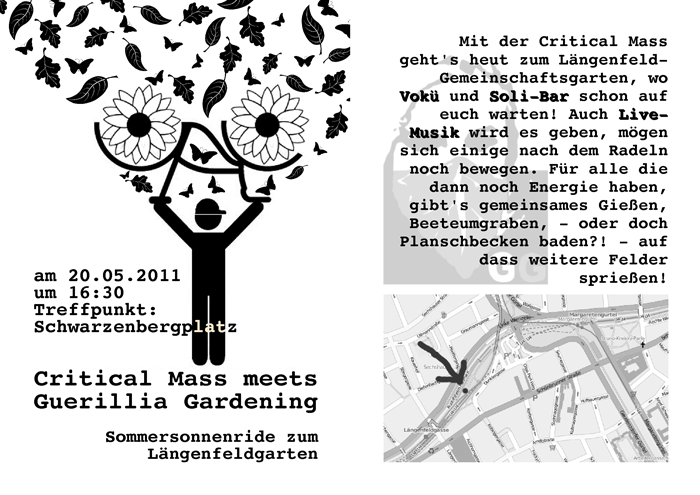
As spring finally had hit Vienna, May's CM was dedicated to team up with Vienna's guerrilla gardening scene. The ride was scheduled to stop at the community garden at Längenfeldgasse where people met up in a nice atmosphere to have a drink and talk after the CM.

May's CM flyer. Critical mass meets guerilla gardening. Flyer via CM Austria.
Bike becoming a habitat. Image by krumpelwumpel.
"One exhaust less!". The environmentalist reasoning is still common over here. Image by krumpelwumpel.

One really stunning experience about riding in a big CM crowd is how the cityscape changes if only bicycles are using the streets. Suddenly it became quiet the residents must have been thinking. Along the most busy roads people suddenly look out of their windows, usually closed to avoid noise from congested or busy roads. With a CM ride passing by there is suddenly at most the noise of a few bells. For you as a rider it is a unique experience to let yourself fall behind to ride among the cars again which follow the CM ride in a grumpy overpowered manner. Among the cars and trucks again, the city becomes the usual noisy busy with traffic environment which we are so used to. Pedaling into the CM ride again one can experience what a city and its streetlife could look like if we reduced the emphasis for the car a little.
Residents which we passed during the ride were stunned by this as well. In almost every house people looked down from their windows or even came to the street to look at the cycling frenzy. It is a perfect moment for distributing flyers to explain the aims and justification for the CM ride.
CM is a good opportunity to see how diverse a city's bicycle culture is. Also in terms of bicycle hardware. Image by krumpelwumpel.

Finally arrived at the community garden in Längenfeldgasse. Image by krumpelwumpel.
Activities to reclaim a previously neglected and unused space within Vienna's urban fabric. Community garden Längenfeldgasse. Image by krumpelwumpel.


Linkliste "Lernen von Fahrradkulturen in Peking und New York"

BEIJING 

http://www.stcbj.com/
"Smarter Than Car (STC) was set up as a platform for promoting cycling, the bicycle life and preserving Beijing’s unique cycling culture."


NEW YORK CITY


http://www.nyc.gov/bikes
NYC - Department of Transportation's bicycle program with several initiatives.

http://www.nyc.gov/html/dcp/html/bike/home.shtml
"The goal of the Department of City Planning, New York City Department of Transportation, and the Department of Parks and Recreation Bicycle Network Development program is to reduce congestion by promoting cycling in New York City."


http://www.youtube.com/user/nycdot
youtube-channel of NYC - Department of Transportation
 
http://www.streetfilms.org/bike-lanes-in-the-big-apple/
Short movie describing the development of bicycle infrastructure in NYC. 


http://www.bikenewyork.org/
"Bike New York is a 501(c)(3) non-profit whose mission is to promote and encourage bicycling and bicycle safety through education, public events, and collaboration with community and government organizations."
 
http://www.ridethecity.com/
Bicycling directions for (as well) New York City. 
 
http://www.transalt.org/
"Our mission is to reclaim New York City's streets from the automobile, and to advocate for bicycling, walking and public transit as the best transportation alternatives."


http://bikingrules.org/
"Biking Rules is a new 'Street Code' for NYC cyclists, following the simple principle that our responsibility to others on the street increases in relation to our potential to cause harm."


www.bikemonthnyc.org
"Each year the Department of Transportation and Transportation Alternatives team up to bring you Bike Month NYC, a city wide campaign to promote the joys of cycling in New York City."

http://rollingcarbon.org/
Rollingcarbon.org calculates the carbon impact of various New York City commutes.
 
http://www.crashstat.org/
"For the first time, all New Yorkers had a way to see pedestrian and cyclist crashes in every neighborhood, enabling them to back up their first-hand experience of dangerous streets with comprehensive hard data."


 Recycle-a-bicycle is a community-based bike shop and non-profit organization that provides educational/job training programs and encourages environmental stewardship and everyday bicycle use.

http://rightofway.org/
"Right Of Way is a group of activists dedicated to asserting the rights of car-free street users -- including pedestrians, cyclists, and skaters -- and fighting back against car domination."


http://www.nycbikepolo.com/
"Bike Polo has been played in New York since 2003. Now, our home court is The Pit at Chrystie & Broome Streets."


http://nybma.com/news/
"The NYBMA is a worker’s alliance of the messenger, by the messenger, and for the messenger. Our mission is to unite, represent and advocate for the bike couriers of New York City."

http://www.fixed.gr/ 
"Home is where the harbl is."


http://www.iparkedinabikelane.org/
"I Parked In A Bike Lane.org is a humble movement aimed at raising driver awareness towards the problems associated with blocking bike lanes."


"I write about mutant bikes, messenger events, bicycle technology and the vast realm of bicycle culture."


http://www.brooklynbybike.com/
"Brooklyn by Bike was born out of a love for traveling around the city by bicycle. Others think we are crazy but we have a passion for our wheels like nothing else."


http://bikesnobnyc.blogspot.com/
"While I love cycling and embrace it in all its forms, I'm also extremely critical. So I present to you my venting for your amusement and betterment." 


http://brooklynspoke.wordpress.com/
"I’m a father, husband, writer, TV producer, comedian, and city cyclist.  Just another voice in the ongoing discussion about city biking."


http://www.bikecult.com/
"The Bike Cult resource, a work in progress, includes listings of bike and cycling groups, velodromes, world and olympic champions, along with excerpts and updates from the book." 


http://newamsterdamize.com/
"We are dedicated to NYC’s Slow Biking Culture, guaranteed 100% Lycra-Free ! Relax. Enjoy your city." 


http://www.astoriabike.com/
"About Bikes and Biking in New York City. Bike, Damnit! Bike!"


http://www.bikehacks.com/
"BikeHacks.com comes to you from both coasts of the USA. We write BikeHacks 'cause we love bikes. We dig up all kinds of cool, interesting and useful stuff, from the funky to the functional." 


http://www.dykesonbikecycles.com/
"We formed in spring ’06 to promote the integration and visibility of the existing community of queer bike riders."


http://www.flickr.com/photos/bicyclesonly/
"the purpose of almost all my photos is to inspire New Yorkers to make everyday trips by bicycle"


http://www.streetsblog.org/ 
"Streetsblog is a daily news source, online community and political mobilizer for the Livable Streets movement." 


 http://www.streetfilms.org/
"Streetfilms produces short films that show how smart transportation design and policy can result in better places to live, work and play."


INTERNATIONAL


http://thecityfix.com/
TheCityFix.com is an online resource for sustainable transport news, advocacy and “best practice” solutions from around the world. 


http://www.copenhagenize.com/ 
"Each and every day roughly 500,000 citizens choose the bicycle in Greater Copenhagen. This blog highlights who they are, why they do and how it was made possible."


http://amsterdamize.com/
"I’m just an Amsterdam native who won’t take his city and its cycling extravaganza for granted anymore, thinking these posts might be clues for others, inspiration perhaps, if you will."


'Warchild' Streetart Project in Bushwick


"A child's silhouette is shaped out of war toys owned and played by the artists during their childhood. The earth's continents are made up of a toy battlefield.
Society is programming war into its youngest. Children are involved and suffer from numerous armed conflicts all over the world. War, a playful game or deadly reality? Some kids play in safety with war toys, while others, in less fortunate situations, may be taught to become child-soldiers or fall victim to the brutal face of war.
Instead of playing with war toys, children should be supported in becoming more tolerant to proliferate peace and understanding within a global society. In Mahatma Ghandi's words: “If we wish to create a lasting peace we must begin with the children”.
See also: meinwe


Learning from Bicycle Cultures in Beijing and New York

I will be giving a talk in Vienna as kind of cultural-learning event to inspire Vienna's efforts in raising bicycle ridership in the city and to support the creative use of pedal-powered vehicles by urban planners, designers and policy makers. The talk will feature Smarter Than Car's research on bicycle culture in Beijing, China and some recent efforts to understand New York's bicycle supporting strategies and specific culture.
The talk and a subsequent discussion will take place on May 18th 6:30 PM at 'Wiener Planungswerkstatt', 1010 Wien, Friedrich-Schmidt-Platz 9.

Poster (click to enlarge)

Outline (German):
Die Unterstützung von Lebensentwürfen die intensive Fahrradnutzung integrieren, kann einen wertvollen Beitrag für lebenswerte und kulturell diverse Stadtlandschaften leisten. Der Vortrag präsentiert Beispiele aus Peking und New York als kreativen Beitrag zur Weiterentwicklung der Wiener Fahrradkultur. In Peking untersucht Smarter Than Car Lebensstile und ökonomische Strategien verbunden mit dem Fahrrad, spezifische Fahrrad-Infrastrukturen und die hohe Diversität der Fahrradnutzung. Ein Blick nach New York zeigt eine stark auf Gemeinwesen aufbauende Fahrradkultur, die in jüngster Vergangenheit von progressiven Strategien der Stadtverwaltung unterstützt wird. Der Vergleich von Fahrradkulturen sowie Gesetzgebungen soll die Diskussion über die Positionierung der Wiener Fahrradkultur ermöglichen.

Scaping the Connecticut River

Last week I got the chance to participate in the 2011 riverscaping learning lab which was held in Springfield, MA and dealt with potentials of understanding the landscape along the Connecticut river between Springfield and Turner Falls as one entity, one region. Thereby regional dynamics may be fostered to develop strategies for the unique landscape along this stretch of the Connecticut river.
 For a first impression I post some panorama images (click to enlarge!) and shots from the bus tour we did to understand the landscape along the Connecticut river.

Springfield. Beautiful and wide waterfront with problems of accessibility and reputation.

Holyoke. Amazing industrial building stock where a computing center will invest because of green energy potentials.

Holyoke. Partly refurbished waterfronts and vast empty building stock.
Hadley. Issues of accessibility to the mostly privatized waterfront.

Turners Falls. Great industrial structure with uncertain future.

This autumn there will be a 'design laboratory' following to develop 'interpretative installations' for specific sites along the Connecticut river in Springfield, Holyoke, Hadley and Turners Falls to allow 'understanding the River as a catalyst for change and growth, and to create connections between communities, ecosystems, and economies along the River.' Follow the developments on the riverscaping homepage to know about the competition.

Creating Agri-cultural Food Systems

The production of food has over the last years received increasing attention by designers and (landscape) architects. Riding the green wave, designers apply agricultural narratives and concepts in an almost redundant manner, producing proposals of various quality, depth and applicability. One can only start to question: Why is this important? What is the benefit from such undertakings?and; How can we successfully do this?
Frank Lloyd Wright 'Broadacre City - Plan for a Living City' (1934-35) (image source archined)
A useful introduction into thinking about how to merry urban life and agricultural production is the concept of 'Agrarian urbanism' as fore-thought in projects by people like Ludwig Hilbersheimer, Frank Lloyd Wright or Andrea Branzi. Today, conditions and assumptions for urbanism are somewhat different than in the mid 20th century and even changed since the nineties of the last century, with shrinking cities needing to be in-filled rather than expanded and cities growing so quickly that a certain density prevents urbanism to reflect on itself. Nevertheless, the thought of an urban model accommodating agricultural production may be re-visited today under more ecological premises, respecting the landscape palimpsest while providing a certain density of urban form to satisfy infrastructural efficacy and human cultural needs.
Looking forward, there is pressing need to further an urban model which is tributing the disappearance of the city-nature dichotomy and which manages to organize a globally networked society in times of resource constraint, climate change and growing need to safeguard food quality, security and access. So the stakes are high in creating the form for the totally urbanising world in the 21st century. In this sense it is great to see more and more grassroots interest in urban farming on one side and intellectual, creative minds on the design side which are engaged in creating (urban) environments integrating sustainable food systems.

'City Farming Project' by Bohn and Vijoen Architects proposing a functioning localized food system for Middleborough, England. (image via David Barrie)
'Farmadelphia', a project by Front Studio proposes agrarian urbanism as infill strategy for urban voids. (image source and credit Front Studio)
 
This week an event at Harvard's GSD aimed at setting the context for contemporary agrarian urbanism. The seminar titled 'Food Systems: Their Deep Impact on Us, the Environment and Urban Structures' was organized by landscape architects Herbert Dreiseitl and Bettina Wanschura and aimed at introducing the concept of food systems (= processes and infrastructure necessary to feed a population) to designers, to enable them to understand their role in re-shaping the current state of the (global) food system.

Global map of nations sized according to agricultural water use per capita (including water for livestock and crop production) (source and copyright: worldmapper).
The importance of re-designing our food systems was emphasized by Herbert Dreiseitl who set the context in his opening remarks. Our currently heavily industrialized food system impacts the environment and society in various ways. (Industrialized) agriculture is the predominant water user and polluter, responsible for major soil erosion and salination and will in the near future run into a wall as it is heavily relying on fossil energy input. The myth of industrialized agriculture being the sole way forward for successfully nourishing the global population has recently been debunked by UN's special rapporteur on the right for food, who identified, amongst others, the support of agro-ecological farming practices and a procurement of public goods instead of (commodity) farming subsidies as viable strategies to ensure food security in developing countries while at the same time successfully counteracting climate change and addressing social justice (source).
So there is tons of work for designers to think about new types of infrastructure which support localized agro-ecological food systems around the globe. Next to mitigating climate change, reducing environmental degradation, such a shift will also increase overall population health.

Bio-dynamic land-use at the Hawthorne Valley Farm. (image via Hawthorne Valley Farm's 'Farmscape Ecology Program')

Martin Ping, the director of Hawthorne Valley Farm, gave a passionate talk introducing the concept of bio-dynamic farming as practiced on Hawthorne Valley Farm since 20 years. Ping offered a real-world introduction into the work, motivation and issues for contemporary farmers in Northern America and how a farm can be sustainable in environmental, social and economic terms. He exemplified the crooked nature of today's food system with the '65000 mile taco', an everyday food item found to embody ingredients of our globalized food system.
'The Global Tacoshed' as investigated by students guided by David Fletcher and REBAR at URBANIlab. (Image source and credit: Rebar)

In his multifaceted talk, Eric T Fleischer bridged microbiology and architecture to foremost emphasize the potentials and importance of advanced and locally adapted closed-loop composting systems which help to maintain microbial biodiversity in the soil. His excellent composting system supporting microbial diversity and thus soil health has been exemplified since years in Battery Park City, NY and was recently adapted to projects such as Brooklyn Bridge Park or the grounds of Harvard University. Fleischer's approach supports the potentials and advantages of working with nature in organically maintaining healthy soils in urban landscapes while closing wasteful material cycles in urban areas.
Simple and efficient closed loop system. The application of a system collecting organic waste and recycling it is by the way the reason for significantly lower amounts of waste generated in European cities which manage organic waste in that way. (image copyright and courtesy of the compost team)

Rachel Schneider, director of the 'Learning Center' at Hawthorne Valley Farm, showed in her talk the valuable work of educating children about food related issues. Her accounts of witnessing children who negate non-processed food or who have no clue what butter is made from underlined the necessity of re-connecting children and young adults to the source of their food, thus making them understand their own food system. Schneider emphasized the importance of education in creating the social demand for healthier food, thereby creating momentum for a future healthier food system. Rachel's work also demonstrates the potential of farms to become places for true agri-culture where education functions as vital part of  social life and public outreach.
Summer camps for children are part of Hawthorne Valley Farm's educational outreach. (image source and copyright Hawthorne Valley Farm Visiting Students Program)

The talks were followed by a lively panel discussion moderated by Christian Werthmann, who guided the conversation around the main question of how to make sustainable (healthy) food systems a reality by identifying specific hurdles and creating visions for overcoming these. As was emphasized during the conversation, only about 1% of US agricultural land is currently farmed bio-dynamically, implying sustainable loops of nutrients and genetic diversity. This number is more or less stagnating over the last decades but will have to be rising sharply if we want to mainstream a healthy food system to a broader population (not only urbanites who can afford to buy exquisite produce from the farmers market).

The role of (landscape) designers in the creation of sustainable food system can be to create environments in which people understand agri-culture as something modern and appreciable. Places where people can integrate a modern life with a job as (part-time) farmer. Along with a structural re-designing process of land-use, farming systems and (maybe most importantly) policy framework, it will be crucial to re-brand agri-culture as a viable life perspective to counteract the aging of the population engaged in agriculture in Western countries. The mean age of farmers in the US is now 57 years (!), and I assume from my own experience that this number is comparable in Europe.
On a societal level, it will be important to re-evaluate and re-appreciate the role of farmers, maybe even renaming 'farmer' to a new word, which more accurately reflects the crucial importance and value of agriculture as a service for land(scape) and society.  A starting point for this discussion can be to identify practices paying tribute to both halves of the word agriculture, to its fractions 'agri' (agros(gr.) = field) and 'culture'. So a practice which work with the field, the land and develops a culture for it, a culture which allows a cultivation as opposed to an exploitation. 
In such context, landscape architects, and especially landscape planners, may spatially apply agri-cultural (agro-ecological) models and typologies to support the visionary development of new agri-cultural food systems. This is true for all environments, regardless their fraction of built-up land on it (I here dont want to discuss urban vs rural or city vs countryside....).
A key success strategy may be to teach sustainable agricultural practices in incubator farms to urban populations to make them understand the importance of healthy food systems. In some cases such students maybe even decide to engage with agri-culture themselves. A suburban incubator farm (maybe even on a vacant lot left behind by a retail giant) may function as a backbone for a sustainable food system with lively flows of food, seeds, knowledge and people between urban and more rural areas and vice-versa. The land-use in such places will be dense and diverse, incorporating; farming and nursing of food crops, showcasing of agri-cultural technologies and strategies, teaching of agri-cultural practices, exchange of experience, facilities for food processing, a functioning marketplace, and, being a place where the culture around agrarian practices can take happen.Designers may give form to such a vision to secure a healthy and diverse food system in the future.