Nuclear China

The recent disaster in Fukushima, Japan has demonstrated that atomic power is a form of energy supply coming with high risks attached which cannot be fully controlled. Now China is starting into on a nuclear future and my recent visit made me aware of the scale of the operation. To quote some numbers:
"Mainland China has 14 nuclear power reactors in operation, more than 25 under construction, and more about to start construction soon.  
Additional reactors are planned, including some of the world's most advanced, to give more than a ten-fold increase in nuclear capacity to at least 80 GWe by 2020, 200 GWe by 2030, and 400 GWe by 2050.  
China is rapidly becoming self-sufficient in reactor design and construction, as well as other aspects of the fuel cycle."  [source]
Urban nuclear energy in Beijing, China. Beijing' s CBD is the conglomerate of darker buildings in the right rear. 
With China becoming a nuclear nation there is growing concern of how safe the industry may be. The recent train accident in Wenzhou province has sparked a fierce controversy and some connect the mistakes made within the railway administration to possible flaws in the nuclear power sector.
"China is embarking on the world's biggest and fastest expansion of nuclear power. The world must pray the industry will somehow prove immune to the curse of corner cutting, secrecy and corruption – or the potential consequences are chilling." [source]
If future events could be wished for like christmas presents, there are two things to write on a wish list:
That China's leaders know the responsibility and risks attached to nuclear power and take the industry serious enough.
That China's expansion of green energy will be more successful and faster that the expansion of nuclear power.

International Invitational Exhibition on OCT-Loft Concept Design


Within the company URBANUS, we recently developed an urban design project dealing with upgrading industrial building stock to be used as a densly productive area for creative industrial production. The project was featured in the exhibition 'Re-Start' in Shenzhen's OCT-Loft cultural district in July and August 2011. Here I want to provide some background info about the project and images from the opening showing the different urban design proposals.
View over OCT-Loft area to be upgraded. (click to enlarge)
OCT (Overseas Chinese Town) was founded in 1985 in Shenzhen and until 1994 OCT industrial enterprises had developed into a corporation with 55 companies under its umbrella. In this regard OCT shows the speed of growth of industry in Shenzhen (and China in general) and that these industries are now increasingly shifting from secondary industrial production to tertiary, service based economies.

As curator Li Sha is explaining the context of the exhibition:
"Since 2004, OCT started to upgrade the remaining East Industrial Zone to the Creative Cultural Park (named OCT-Loft). The upgrade of the Eastern Industrial Zone in Overseas Chinese Town to the Creative Culture park (OCT-Loft) shows it only took 26 years to complete the transformation of a European industrial city that was projected to take 100 years. [...] 
In recent decades, with the transformation and decline of large industrial systems in Europe and in the US, the protection and regeneration of earlier industrial heritage became a trend. The industry was upgraded as the region became increasingly more well known; however, the site is protected both by a respect for the natural surroundings and by archaeological practices, one that places extreme respect on the context and space. [...] 
'Landschaftspark Duisburg Nord' (Latz&Partner, 1990-1999). Industrial heritage carefully re-purposed with respectful archaeological approach. (Image source: wikipedia)

Upgrading of these areas will undoubtedly protect the industrial architectural heritage, and enrich the city's creative cultural space, but they have several issues: the area is difficult to adapt to the rapidly changing urban space; the aim for future development is unclear, and it could easily be transformed into a high-end fashion area; the area may have difficulty meeting the demand for new space in the region.
Zeche Zollverein in Essen, Germany. (image source and credit: Claus Moser @ Flickr)
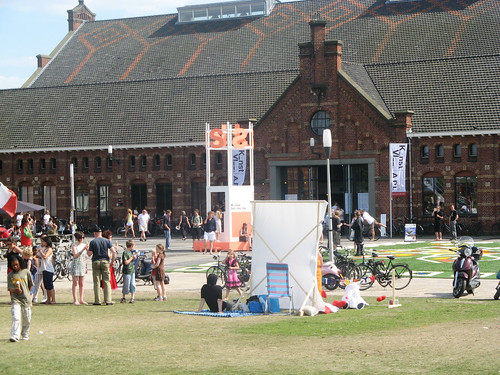
Culturpark Westergafabriek. An old gasworks site refurbished to allow urban cultural events and host creative industrial entrepreneurs. (image by PLANETART @ Flickr]
Culturpark Westergasfabriek, Amsterdam. The old 'gashouder' (gas storage tank) used for an exhibition. (image by Bas Boerman @ Flickr)
Culturpark Westergafabriek. The same gas storage tank as above used for a rave event. (image by Gia Vasilevska @ Flickr)
In fact, in Europe, another mode co-exists with the aforementioned strategy, that is the active protection mode. This mode also pays attention to the industrial architectural heritage and regional studies, but it is more concerned about the contemporary significance of the architectural and regional improvement. [...] 
The exhibition invited Bernard Tschumi Architects (New York / Paris), Dominique Perrault Architecture (Paris), MVRDV (Rotterdam), Urbanus - Architecture and Design (Shenzhen /Beijing) and Sou Fujimoto Architects (Tokyo) to offer thoughts on the OCT-Loft conceptual plan and the renovation of B10 into the OCT Contemporary Art Museum, exploring the strategy for the active protection of the industrial building."

It is fair to say here that this 'respect mentioned by Li Sha is not always a given in Europe. It is not uncommon that private as well as public investors just dont acknowledge or can imagine the heritage value of industrial buildings dating back a few decades. The problem in such a case is: you loose a type of architectural heritage, a unique form of space, which would be able to host an array of diverse events, being it cultural or representational. Such rough industrial heritage spaces may also provoke creative re-actions in these spaces which are impossible to create in sleek museum-like environments.There is something to architectural form which was created for another purpose in the past. So the really creative and culturally valuable act is actually a (sometimes temporary) re-purposing of industrial architectural heritage.
After this more theoretical and contextual introduction please have a look at some images of the contributions:

Bernard Tschumi Architects


Domique Perrault Architecture


MVRDV

URBANUS


Sou Fujimoto Architects

Bicycle Kitchens in Shenzhen

Talk: New York's Pedal Power and Beijing's Bicycles

This Thursday, Smarter Than Car is hosting a lecture in Beijing, where Shannon, Liman and me will present some of our current research about bicycle culture in Beijing and New York. This event is a preview to an upcoming talk which STC will give at ‘UIA2011 Tokyo – The World Congress of Architecture’ later this year.
See the flyer for details (click to enlarge)

Water in Hong Kong


Passing by the drainage system of Hong Kong island, I am starting to think about water issues in Hong Kong (HK), a city highly dependent on water supply from outside. One third of Hong Kong's surface is developed as water catchment area which is not enough to meet high water demand, even despite average annual rainfall in HK amounts to about 2400 mm. Therefore Hong Kong imports about 70 % of its water needed for industry and private use.
There are systems in place which help to reduce water dependency, such as a seawater toilet flushing system and several desalination plants. From a landscape perspective it is interesting that in Hong Kong even ocean bays (or arms) have in the past been fenced off from seawater and are now used as freshwater reservoirs. When it comes to water large scale landscape interventions have always been possible.
From a design (research) perspective it would be interesting which up-to-date (green) infrastructure measures could be inserted into the landscape of Hong Kong to harvest rainfall and mist and to which extent they would help to alleviate outside water dependency. 

Guangzhou Bicycle Culture


I was amazed about the bicycle culture in Guangzhou, Gunagdong, China. When moving through the city, one gradient becomes apparent soon: the occurence of bicycles and their use in providing everyday amenities (mobility, transport and other services) is inversely correlated to the motorization of the urban fabric. Cars rule the streetlife more and more in China but the speed of takeover is not the same everywhere. In Shenzhen for example, cars are the only force on the road (as pedestrian you better watch out and run!). However there seems to be a different understanding persisting in the streets of Guangzhou, where people are walking in the middle of the street in the evening and sidewalks are occupied by street vendors and bicycle servicemen.
Also when visiting the older parts of town it is interesting to see how cars penetrate the streets which havent been designed for cars, and are thus finding their limits in small, narrow old streets where only pedestrians and bicycles can access. Within such neighbourhoods existing on the scale of a mini-blocka type of urban life unfolds suddenly to the visitor, a very urban and humanely loud and busy streetlife which is (to my experience) unknown to Europe and more and more diminished in China as well. Spontaneous street markets on tricycles, groups of women chatting in the street, kids and grandmas walking puppies in the road and grandpas hanging out in their chairs on the street. Such qualities I believe are worth extracting from life in the old urban fabric and can be brought into the design of small subunits of urban developments.

I am aware but wont discuss here the fact that such urban life is also tied to a certain income level and related issues of social disparity in modern China. For sure this is a cumulative effect of socio-economic factors and very difficult to address, but social upgrade of low-income classes is not prevented by the use of bicycles and the life in the old urban fabric. It may on the other hand be a viable strategy for urban development to develop unique urban qualities such as community life and streetlife - which are to a greater extent found within a dense and non-motorly mobilized urban fabric on a human scale - for the benefit of the residents.